
Uncategorized
RICH MIND VS POOR MINDSET.. THE THINKING THAT SHAPES YOUR WEALTH

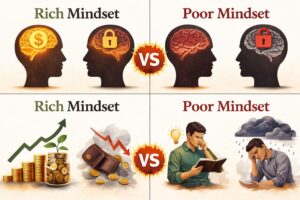
Rich Mindset vs Poor Mindset.. Means what..?
Have you ever wondered why some people build wealth, while others struggle financially, even when they earn the same income? The difference has little to do with luck, intelligence or education. In fact, it comes down to the powerful factor mindset. The way people think about money shapes their financial decisions everyday. The strategy lies within the rich mindset and the poor mindset.
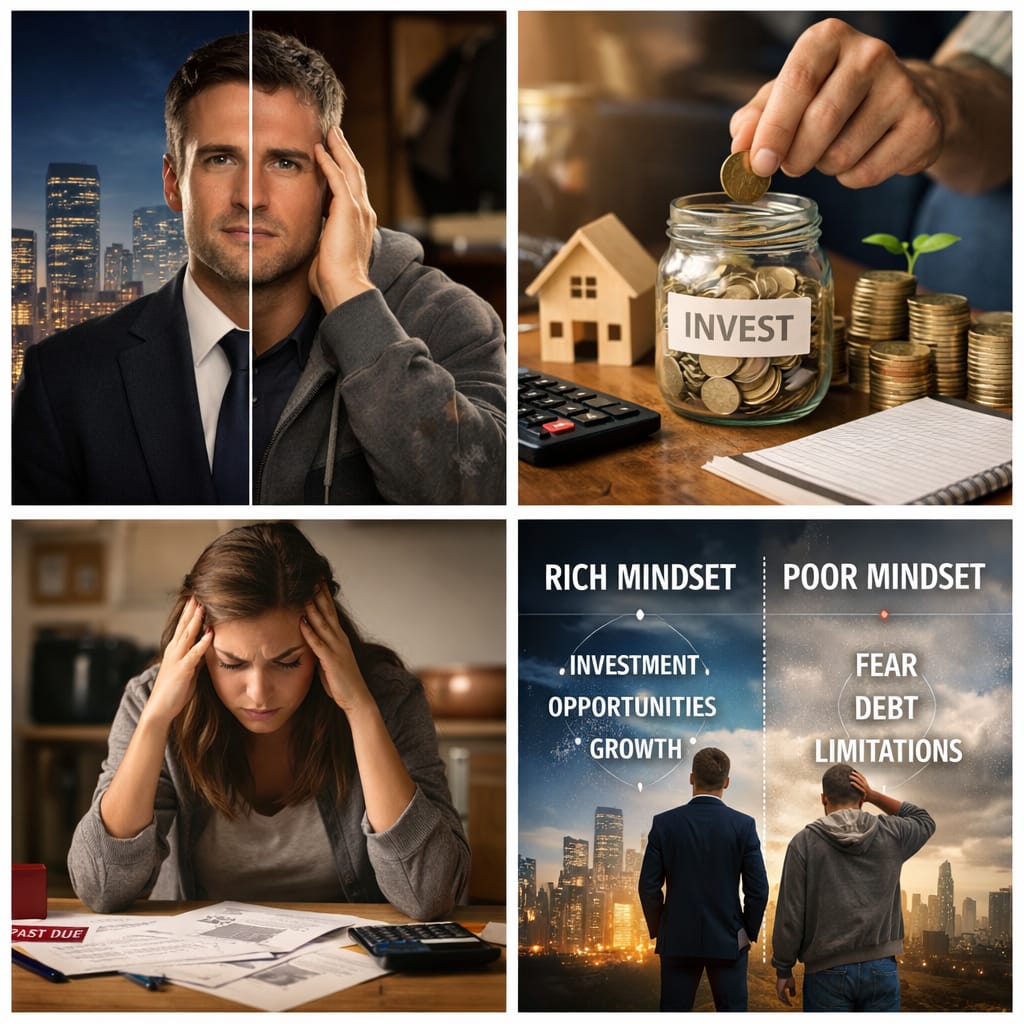
Those with a rich mindset tend to focus on opportunities, growth and long-term wealth. In contrast, a poor mindset often focuses on limitations, short-term pleasure and fear of financial risk. Understanding the difference between these two mindsets, can completely change the way to manage money and build wealth. “In this article, we will explore rich mindset vs poor mindset and how it impacts your financial future.
“What is a Rich Mindset in Rich Mindset vs Poor Mindset?”
A rich mindset is a proactive, growth -oriented perspective, a long term approach to life and finances that view money as a tool for investment, appreciates abundance, growth and opportunity, embraces instant gratification and calculated risks over scarcity and fear.
“Here are key habits in rich mindset”:
● Abundance mentality: Believes there are always opportunities, rather than thinking wealth is limited.
● Accountability: Taking full responsibility for actions and financial situations, rather than blaming others. ( Victim mentality).
● Life long learning: Actively seeking to learn new skills to improve and grow.
● Long term thinking: Trading immediate pleasure (instant gratification) for future benefits, such as investing instead of over spending.
● Creating value: Focusing on producing or creating value, products or services that help others.
● Calculated risk & resilience: Viewing a failure as a learning opportunity rather than a reason to quit.
Related terms to Rich Mindset:
● Abundance mentality
● Growth mindset
● Entrepreneur mindset
● Success mindset
● Wealth consciousness
● Financial Intelligence
● Proactive attitude
Examples of Rich Mindset:
● Instead of asking, “How can I afford this?” You ask “How can I produce enough value to earn this?”
● Instead of avoiding projects due to fear, take a ‘calculated risk’ to invest in a business opportunity.
Understanding the Rich Mindset and their long term thinking in Rich Mindset vs Poor Mindset:
People’s thoughts about money are highly subjective and often assumed by their financial situation, opportunity, luck or any external factors – but the truth lies in how the wealthy think. Their habits, mindset and principles create a framework that not only helps them accumulate their wealth but also sustain it over time. In this article, we will understand the psychological traits, habits and mental strategies that define a wealthy individual and their long term thinking which contributes to their financial success.
Rich Mindset/Growth Mindset:
The psychologist Carol Dweck explained that the psychology of wealth is about growth mindset. Wealthy individuals accept the challenges and see failure as an opportunity for learning. Viewing obstacles as unconquerable, they see them as stepping stones to success.
Long term thinking of Rich Mindset:
● Seek opportunities for self – improvement and continuous learning.
● Seeking challenges as opportunities for growth.
Parsimony and mindful spending:
Many rich individuals live below their means and focus on value over luxury. They might spend on high valued products, but as they are mindful, they know where their money goes. This Parsimony allows them to accumulate and reinvest their wealth.
Long term thinking of Rich Mindset:
● Track their spending and ensure their lifestyle within their means.
● Focus on long term wealth accumulation.
Network and relationship:
An individual’s effort cannot build wealth – it depends on an individual’s network and relationships. A wealthy individual is always surrounded by business partners, mentors, advisors who help in growing their wealth.
Long term thinking of Rich Mindset:
● Build and maintain a strong professional network.
● Seek out mentors who can offer guidance and insights.
Financial literacy and education:
The wealthy individuals will prioritize financial education.They will understand the concept of how money works. From the basics of budgeting tocomplex things like tax, investing, retirement planning, optimization, market trends and opportunities, wealthy individuals will seek to educate themselves by gaining knowledge and staying updated as per the current scenario.
Long term thinking of Rich Mindset:
● Invest in education as a means of long term wealth accumulation like reading books and attending seminars.
● Regularly update their financial strategies based on new information.
“What is a Poor Mindset in Rich Mindset vs Poor Mindset?”
A poor mindset also known as scarcity mindset is a psychological framework rooted in scarcity, believing that resources, opportunities and success are limited. It is an unconscious, fear based approach to life focused on limitation, immediate gratification and avoiding risk rather than growth.
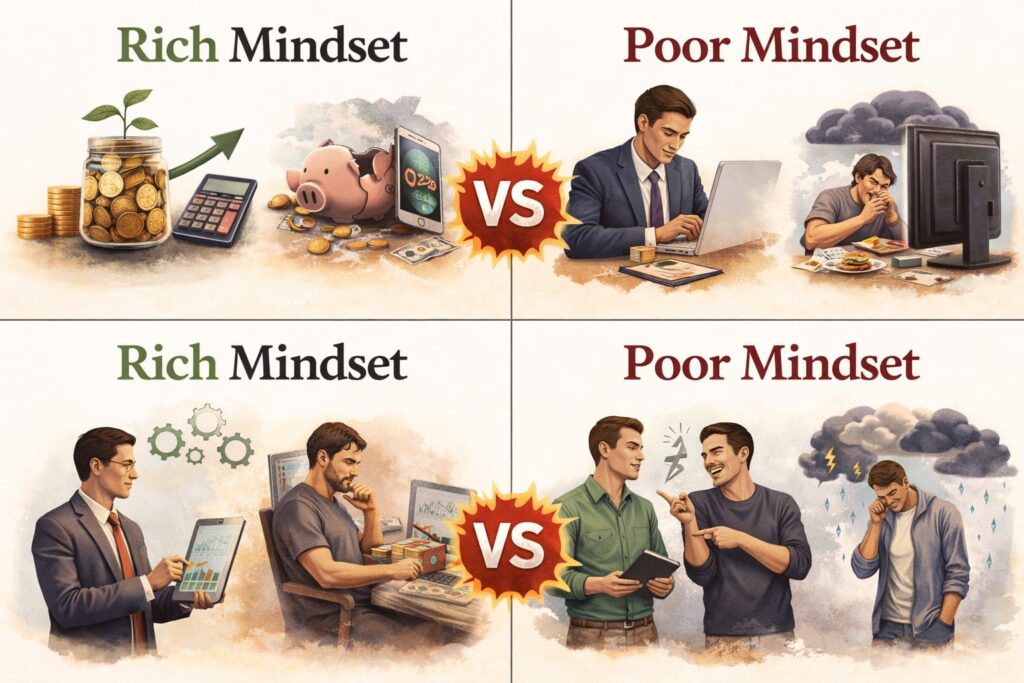
Here are Key habits of a Poor Mindset:
● Fear based decision: Avoiding investments in education, networking or business opportunities due to fear of failure.
● Victim mentality and complaining: Frequently blaming others or the circumstances for financial failing, rather than taking responsibility.
● Instant gratification: Prioritizing immediate consumption and comfort over saving, investing or any other long term planning.
● Scarcity thinking: Believing resources (time, money, opportunity) are limited and someone else’s gain in their loss.
● Underinvestment in self: Focusing on saving money rather than investing in personal growth, skills or knowledge.
Related terms of Poor Mindset:
● Scarcity mentality
● Poverty consciousness
● Fixed mindset ( regarding finances)
● Short termism
● Victim mentality
Common examples:
● Believing money is meant to be spent, not invested.
● Feeling trapped in a financial situation.
● Comparing self with others and feeling perpetually behind.
Common limiting Beliefs about Money in Rich Mindset vs Poor Mindset:
A poor mindset is characterized by scarcity thinking, fear based financial decisions and short-term focus, which can trap individuals in a cycle of financial struggles regardless of their actual income.
● Money is the root of all evils: Viewing wealth as immoral creates subconsciousself- sabotage.
● It takes money to make money: A belief that keeps people from starting business or investing small amounts, waiting for a large capital that never comes.
● Money is scarce / hard to make: A scarcity mindset leads to hoarding resources or avoiding risks, rather than generating more value.
● My family has never been rich: A belief that poverty is a hereditary fate rather than the condition that can be changed.
Short -term thinking traps of Poor Mindset:
The poverty mindset focuses on immediate gratification rather than long-term security.
❖ Impulsive Spending: Spending money, for the sake of maintaining status, immediately on luxury or entertainment instead of saving or investing for the future.
❖ Lottery Mentality: Looking for “get – rich – quick” schemes or waiting for a windfall rather building sustainable wealth through strategy and patience.
❖ Ignoring Financial Planning: Believing that the budget is only for rich people. Tracking expenses due to fear or overwhelming feelings about a lack of money.
Financial Struggles of a Poor Mindset:
These habits are often lead to repeated financial crises, regardless of income changes :
★ The Debt trap: Using credit cards for non- essentials to cover monthly expenses, leading to high interest debt that reduces future freedom.
★ Living Paycheck to Paycheck: Regardless of income level, a scarcity mindset often results in spending all available funds.
★ Fear Based Investing: Being too conservative with money due to fear loss, which results in losing purchasing power to inflation.
“Key Differences in Rich Mindset vs Poor Mindset Explained”:
A rich mindset focuses on growth and building assets, whereas the poor mindset focuses on scarcity and limitations.
Key difference between the Mindset:
● View of money:
Rich Mindset: View money as a tool to create wealth through investments and savings.
Poor Mindset: View money as a source of income to be spent on liabilities and immediate consumption.
● Time Horizon:
Rich Mindset: Focuses on long term goals, sacrificing short term goals for future success.
Poor Mindset: Focuses on short term growth, prioritizes instant gratification and immediate comforts.
● Learning and Growth:
Rich Mindset: Possess a “growth mindset”, constantly learning and developing new skills.
Poor Mindset: Often believes as it “knows enough” and is closed-minded.
● Perspective on Risk and Failure:
Rich Mindset: Rich embraces calculated risk and sees failure as a learning opportunity.
Poor Mindset: Fears change and risks, avoiding potential failure, often resulting in stagnation.
● Action and Accountability:
Rich Mindset: Rich mindset is proactive, takes initiative and responsibility for their financial strategies.
Poor Mindset: Often adopts a “victim mentality”, complains about unfairness and blaming external factors for their financial situations.
REFERENCE:
https://share.google/qyLVA9WsNnapFTKyi
Reference for Rich Mindset vs Poor Mindset:
https://sumermannwings.com/emotional-intelligence-superpower-guide/
https://sumermannwings.com/psychology-of-money-2/
“Below is a clear comparison of rich mindset vs poor mindset:”
| Aspect | Rich Mindset | Poor Mindset |
| Thinking Style | Focuses on growth and opportunities | Focuses on problems and limitations |
| Money Belief | Money is a tool to build wealth | Money is scarce and hard to earn |
| Spending Habit | Invests in assets and education | Spends on liabilities and pleasure |
| Time Perspective | Long -term thinking | Short-term thinking |
| Risk Approach | Takes calculated risks | Avoid risks due to fear |
| Learning | Continuously learns and improve | Avoid learning new financial skills |
| Income Strategy | Multiple income sources | Depend on one source of income |
| Reaction to failure | Learns from mistakes | Blames others |
| Attitude towards others success | Gets inspired | Feels jealous or discouraged |
CONCLUSION:“Understanding rich mindset vs poor mindset can completely change your financial future.”
In the end, the difference between the Rich Mindset and Poor Mindset is not about how much a person earns, but it shows the capability of a person, how the money and the opportunities are managed. The rich mindset will focus on long term growth, building assets and education, on the other hand, the mindset of the poor will always focus on fear, financial risks, short term satisfaction, limitations etc.
But the good news is mindset is something that can be changed. Developing better financial habits, learning skills, and thinking of money for a long term can definitely build healthier relationships with wealth. Remember one thing, financial success is not determined by income but it is defined by your decisions and attitudes we develop over the time.
<!– wp:post-terms {“term”:”post_tag”,”suffix”:”difference between rich and poor mindset\u003cbr\u003ehow mindset affects financial success\u003cbr\u003ehabits of rich vs poor people\u003cbr\u003ehow to develop a rich mindset\u003cbr\u003epoor mindset financial struggles\u003cbr\u003epsychology of wealthpersonal finance tips\u003cbr\u003ewealth building strategies\u003cbr\u003eself improvement\u003cbr\u003esuccess mindset\u003cbr\u003efinancial freedom\u003cbr\u003emoney habits\u003cbr\u003einvesting mindset\u003cbr\u003emillionaire mindsetgrowth mindset and wealth\u003cbr\u003eabundance vs scarcity mindset\u003cbr\u003efinancial success habits\u003cbr\u003emindset and money\u003cbr\u003ehow to build wealth mindset\u003cbr\u003efinancial education\u003cbr\u003elong term vs short term thinking\u003cbr\u003emindset for success\u003cbr\u003erich mindset vs poor mindset\u003cbr\u003erich vs poor thinking\u003cbr\u003ewealth mindset\u003cbr\u003epoor mindset\u003cbr\u003emoney mindset

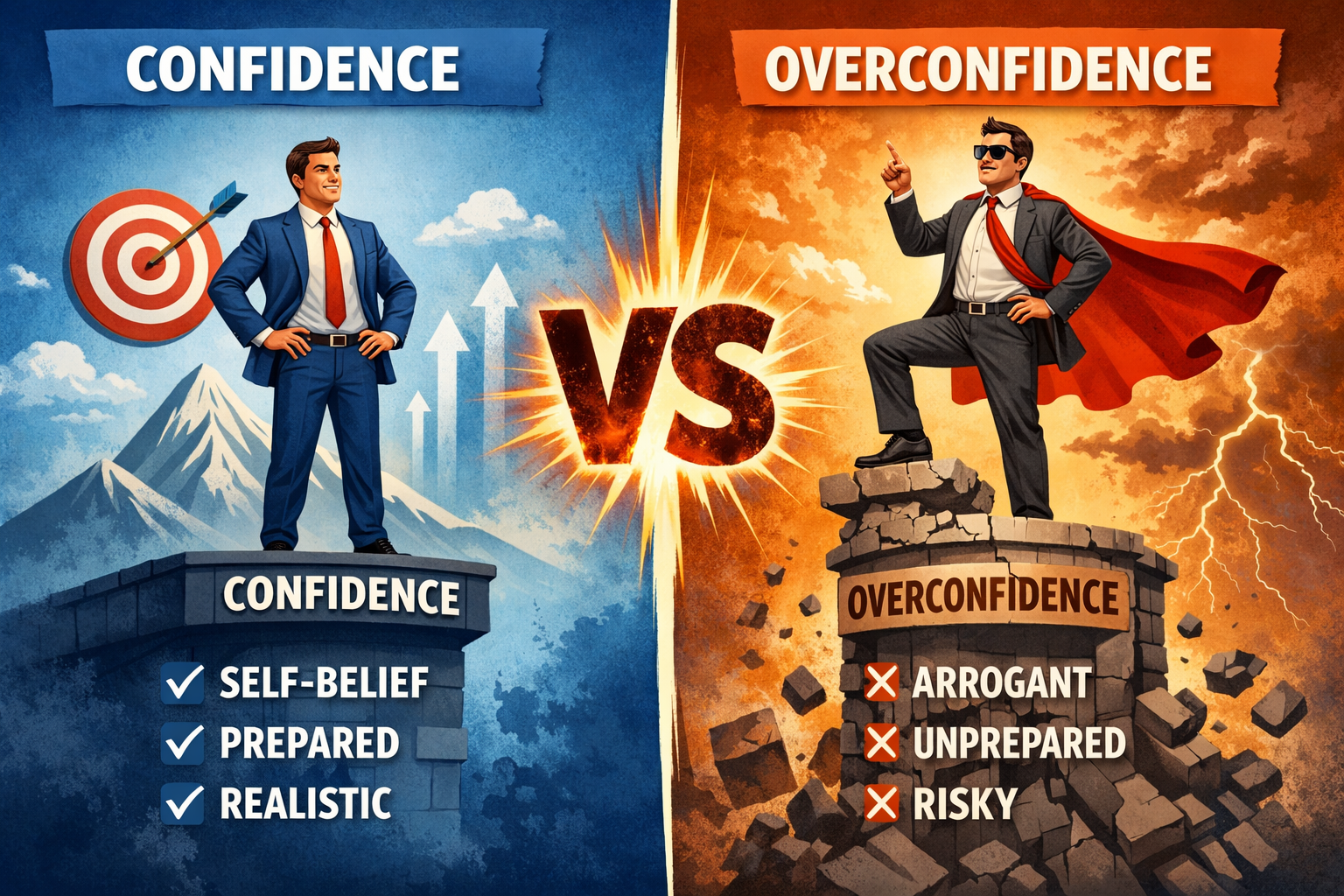
Confidence vs Overconfidence: A Small Story That Reveals the Truth:
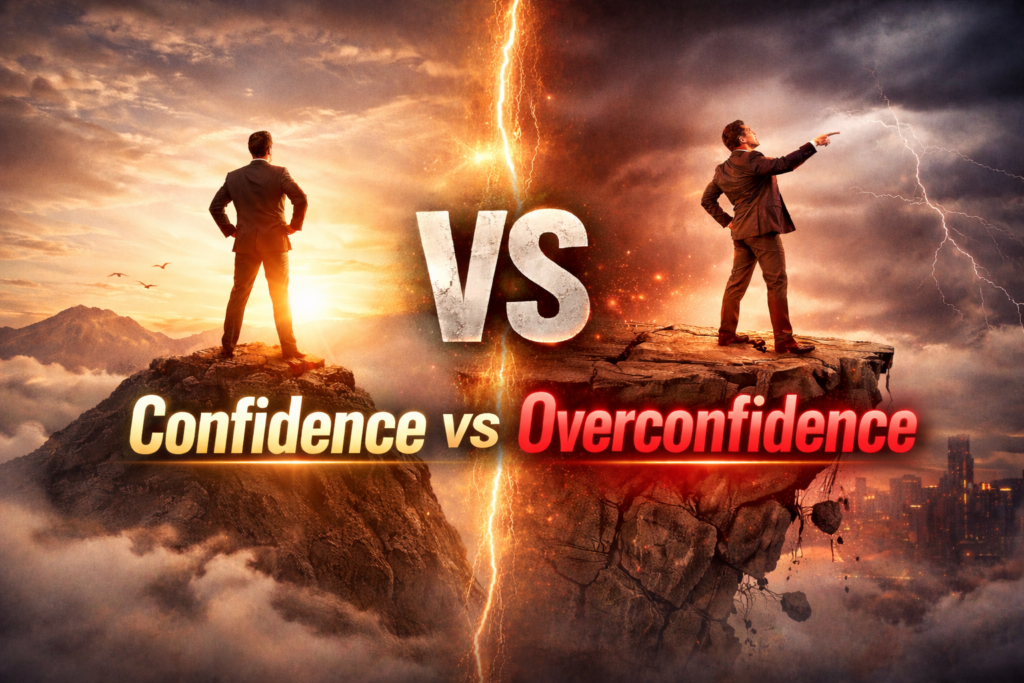
The Power of Karma teaches us that every action creates our future, then there is something even deeper that controls those actions – Confidence. But here’s the truth most people don’t realize, the real battle is not just about confidence it is about Confidence vs Overconfidence. And the line between them is so thin that many people cross it without even knowing.
Confidence can lift you to great heights, while overconfidence can quietly lead you toward failure. The difference may seem small, but its impact on your life is profound. Understanding Confidence vs Overconfidence is not just about personality—it is about the choices you make, the actions you take, and ultimately, the life you create.
What is confidence..?
Confidence is essentially a state of mind characterized by a firm belief in yourself, your powers and your abilities. It is the internal conviction that you can meet life’s challenges and the willingness to act on that belief. It is the courage in reaching the goal, a trust in self, a feeling that you are sure about your abilities, opinions.
The story of Confidence starts with a Journey:
One day, Confidence decided to walk through the world and observe how it influences people’s lives. As it moved forward, two shadows appeared beside it. Surprised, Confidence asked,“Who are you and why are you coming along with me?” The first one smiled gently and said, “I am Self-Confidence, your positive reflection.” The second one laughed proudly and said, “And I am Overconfidence, your darker side.”
Confidence was confused.“I don’t need both of you. I already have my courage, belief, and strength.” Self-Confidence replied softly, “We are not separate from you… we are your reflection, your shadows, we are what you become in different situations.” Confidence understood their presence and so, all three of them continued their journey together.
Confidence vs Overconfidence in Real Life: The Workplace Lesson :
All the three entered an office filled with ambition and competition. Confidence said, this is the place where I required the most in each and every employee. There, they noticed a young woman from a small town. She had big dreams, but her colleagues constantly mocked her background. Many of them were filled with overconfidence, they believed they were superior. But their arrogance blinded them. Meanwhile, the young woman, though quiet, carried self-confidence within her.
She worked hard, stayed focused, and believed in herself. Time passed and she got promoted. Those who were overconfident were left behind. But instead of celebrating her success, they began to ignore and insult her. Slowly, even her self-confidence started shaking. Confidence looked at this and felt pain. Seeing this, Confidence started losing its hope and generosity of helping people.
Confidence vs Overconfidence in Family Life: A Hidden Struggle:
Nextly, they entered a home. A newly married woman had just entered the family. She was educated, strong, and confident , a lawyer by profession, but didn’t knew the household works. Instead of guiding her, the family constantly taunted her. Her confidence slowly turned into doubt. Her self-respect, courage and confidence began to fade. Overconfidence whispered proudly, “You see? I rule this world. Ego, jealousy, pride, temperament – these are what people follow today.” Self-Confidence stood in silence as it was unable to fight the negativity around.
Confidence vs Overconfidence: Understanding the Real Difference :
Seeing both the events at two different places, Confidence also started losing courage and always its responsibility of serving everyone. At this time, Self-Confidence says to Confidence, ” As me being your positive side, I totally feel helpless as comparing your negative side” (i.e) your Over-confidence. Overconfidence laughed and said, “People want fast success. They don’t care about values. I give them power quickly through ego, comparison, dominance, jealousy and pride to all human beings, and this is what they crave for.”
On the other side, Self-Confidence replied calmly, “But what you give is temporary. I build something deeper, self-respect, dignity, and lasting success.” Today’s people live in a fast and furious life style, where only speed matters and not the appropriate result. And negativity comes at a faster pace than positivity. Confidence finally understood the truth:
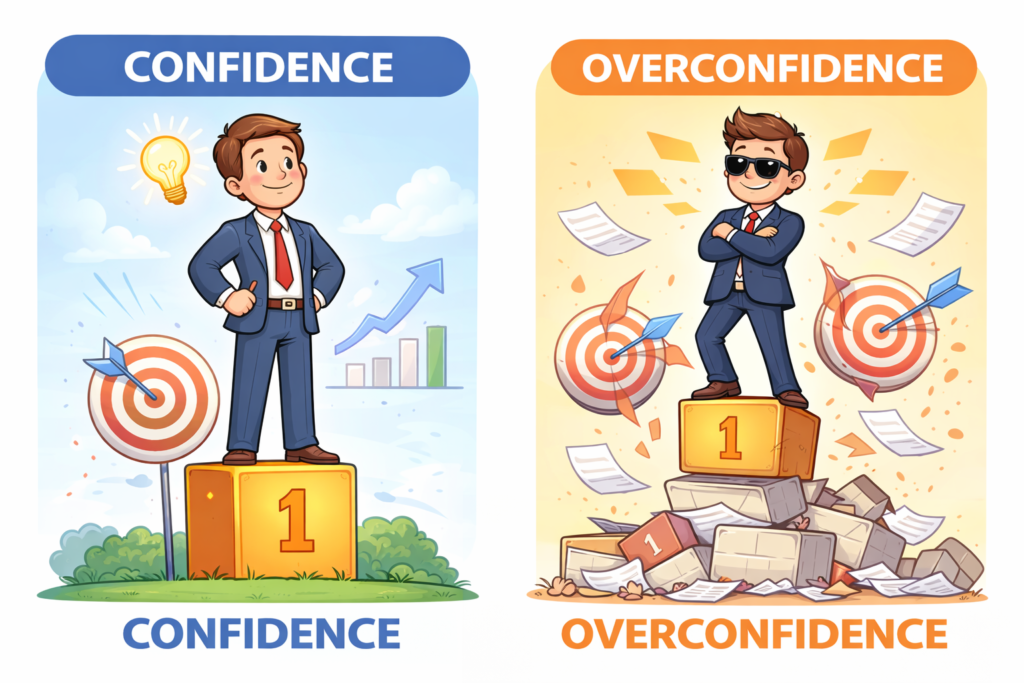
Overconfidence gives quick rise but leads to downfall.
Self-confidence grows slowly but creates lasting strength.
Confidence vs Overconfidence: How It Shapes Your Actions and Life :
OverConfidence said – Nepotism, Barbarism, Greediness, Egoism, Status Symbol, Temperamental- all these behaviours are because of me. I joined you both in the walk, just to show how people are addicted to my tools and follow my rules and leave the place and go away. Hearing this self -confidence says- Even though I spread positivity but I’m left alone. Confidence says, ” Don’t worry..!! This is all short term popularity which brings a long time humiliation at the end.
Confidence vs Overconfidence: Which One Are You Choosing? :
The deeper connection to life is also just like the Power of Karma, confidence works silently. Your actions create your life. But your confidence decides those actions and if your confidence is rooted in ego, your karma will reflect negativity. If your confidence is rooted in self-belief and humility, your karma will create growth and peace.
At the end of the journey, Confidence smiled and said: “Choose wisely who you follow – your self-confidence or your overconfidence. Because in life –
Self-confidence builds you overconfidence destroys you
and just like karma… What you choose today will shape your tomorrow.
CONCLUSION:
The truth is simple but powerful: Confidence is not about proving others wrong. Infact, it is about believing in yourself without losing your humility. In a world driven by speed, comparison, and ego, understanding Confidence vs overconfidence becomes more important. One builds your character while the other slowly destroys it from within.
Choosing self-confidence is not easy, but it is the only path that leads to true success and inner peace. So, nurture your self-confidence. Protect it. Strengthen it. Because in the end, the balance between Confidence vs overconfidence is what shapes your actions and when your actions are right… your life transforms.
REFERENCE:
https://share.google/CY92OdfsOUz0T4jNJ
REFERENCES:
https://sumermannwings.com/the-power-of-karma/
https://sumermannwings.com/powerful-prophecies-of-lord-mahavir/
https://sumermannwings.com/the-truth-of-life-and-soul/
https://sumermannwings.com/soul-and-enemies/
<!– wp:post-terms {“term”:”post_tag”,”prefix”:”motivational blog\u003cbr\u003elife advice\u003cbr\u003einspiration daily\u003cbr\u003econfidence vs overconfidence\u003cbr\u003eself confidence\u003cbr\u003eoverconfidence\u003cbr\u003econfidence tips\u003cbr\u003epersonal development\u003cbr\u003epsychology of confidence\u003cbr\u003eego vs confidence\u003cbr\u003esuccess habits\u003cbr\u003elife lessons\u003cbr\u003emotivation\u003cbr\u003emental strength\u003cbr\u003elife improvement\u003cbr\u003e”} /–>
Why do good people suffer.?? Have you ever paused and wondered why life unfolds the way it does? Why do some moments bring unexpected joy, while others arrive as silent lessons wrapped in pain? Is it all just coincidence… or is there something deeper guiding every experience? The answer lies in the Power of Karma – an invisible force quietly shaping your journey with every thought, every word, and every action.
In the rush of modern life, we often chase instant success and quick happiness, forgetting that life doesn’t respond to wishes – it responds to actions. The reality you are living today is not co-incidence, it is a reflection of the energy you have created in the past, and the life you dream of? It is being built right now, through the choices you make in this very moment.
Is everything in life because of KARMA..? The most powerful truth is this: you are not a victim of fate, you are the creator of your destiny. Once you truly understand the Power of Karma, you begin to see that every small action holds the potential to transform your entire life.

WHAT IS THE POWER OF KARMA?:
What Is KARMA..?:
According to any religion, karma is the basic principle within a comprehensive psycho – cosmology. Human moral actions forms the basis of transmigration of the soul. Karma is identified as the relationship between a person’s mental or physical action and the consequences following that action. The spiritual principle of cause and effect which is often described as, “what goes around comes around”, impacting the current life and future reincarnations.
Understanding the law of cause and effect:
The law of cause and effect states that every effect (outcome/ event) has a specific cause and every cause (action/thought) has a specific effect, meaning nothing happens by chance. This law is also called the “iron law of the universe”. To understand this law, here are the key aspects of this law:
● It applies to all aspects of life, including health, relationships and financial success.
● Everything happens for a reason, whether good or bad.
● This law suggests if you want a different result (effect) you must change the action or thought (cause).
● People living “at cause” takes responsibility for their outcomes, while those “at effect”may feel like victims of circumstances.
Usage examples of UNIVERSAL LAW of CAUSE and EFFECT in Power of Karma:
| CAUSE | EFFECT | |
| 1. | studying and gaining new skills | career development |
| 2. | saving and investing money | financial independence |
| 3. | Rain | wet streets |
| 4. | consistent exercise and eating well | better physical health |
| 5. | Acting with Kindness and Empathy | fosters positive loving relationship |
Karma and Law of Cause and Effect :
Karma is the spiritual equivalent of the universal law of cause and effect, where every intention, thought and action serves as a seed (cause) that eventually matures into a corresponding experience (effect). Karma is effectively the cosmic law of “reaping what you sow”, ensuring that life is not random but a result of personal choices and actions.
THE POWER OF KARMA:
The power of Karma empowers individuals to shape their destiny through conscious, ethical choices, reinforcing personal responsibility rather than fatalistic resignation.
Key Aspects of THE POWER OF KARMA:
● The power of intention: Karma relies heavily on the motivation behind an action, a harmful intention creates a stronger negative karmic seed than an accidental action.
● The great law: Karma is not pre-determined, it is not a punishment or reward. It is a natural law stating that individuals create their own future by their actions, whatever energy you put into the world will return to you. If you put positive actions (kindness, compassion) leads to positive outcomes, while harmful actions create negative experiences.
● Instant vs delayed effects: While some consequences are instant, others take time to”ripen”, carrying over across days, years or even sometimes unfolding in future reincarnation.
● Reversing passed Karma: Understanding karma as cause-and-effect, allows that for personal transformation, by changing current actions, behaviour, thoughts and increasing awareness, one can shift the trajectory of their future i.e. breaking the cycle of negativity.
● System of Accountability: Often called the”law of cause and effect”, it ensures individuals face the outcomes of their deeds, acting as a guide for Ethical behaviour.
● Physical and mental realm: This law applies to both actions in the physical world (eg: touching a hot stove causes pain) and mental actions (eg: nurturing hatred causes unhappiness).
HOW THE POWER OF KARMA SHAPES YOUR LIFE:
Many people believe that life is controlled by luck or fate, but the truth is far more empowering. The power of Karma teaches us that we are the creators of our own reality. Karma shapes your life by acting as a universal law of cause and effect.

Keyways How Karma Shapes Your Life :
❖ When you act with kindness, you attract positivity.
❖ When you spread negativity, it returns in different forms like self-sabotaging patterns in relationships and success.
❖ When you work with honesty and dedication, success follows.
❖ When you fall into repeating patterns such as self – sabotage, consistent career challenges or toxic relationship loops – they are the reflections of unresolved “Karmic debt”.
❖ Karma will determine whether you live in a supportive environment or one filled with challenges.
❖ While past actions create situations, your present decisions allow you to shape your future. You are not the victim of fate, you are the designer of your destiny.
REAL LIFE EXAMPLES OF THE POWER OF KARMA:
★ Have you ever helped someone and later received unexpected support?
★ Have you noticed how negative thinking brings more stress and problems?
★ Have you seen how consistent efforts lead to growth and success?
These are not co-incidences, but the power of Karma in action. Life always responds to your energy.
HOW TO USE THE POWER OF KARMA TO TRANSFORM YOUR LIFE:
The most beautiful part about karma is you can change your life by changing your actions. Here are simple ways to create good karma:
1. Practice Kindness – Small acts of kindness create powerful positive energy.
2. Be Mindful of Your Thoughts – Your thoughts are the starting point of your actions.
3. Speak with Honesty and Compassion – Words have power, use them wisely.
4. Let Go of Negativity – Holding onto anger or jealousy only harms you.
5. Take Responsibility – Stop blaming fate, your actions shape your future.
THE DEEPER TRUTH ABOUT THE POWER OF KARMA:
The deeper truth about Karma is that it is not a system of cosmic punishment, revenge or rigid fate, but rather the neutral – impersonal law of cause and effect operating at a spiritual and psychological level. The core of Karma is not the action itself, but the intention behind the action which creates mental imprints that shape future experiences and character. Every action you take is like planting a seed. With patience and consistency, those seeds grow into the reality you experience.
CONCLUSION:
The most powerful truth you can understand is this that your life is not a matter of luck, it is a reflection of your actions. The Power of Karma reminds us that we are not helpless in this journey. We have the ability to shape our future through what we choose to think, say, and do every single day. So, if you want a better life, don’t wait for the world to change, start by changing your actions. Because in the end, the energy you give to the world is the life you create for yourself.
REFERENCE :
https://share.google/Kyb7AzWa9oXX28KRZ
REFERENCES:
https://sumermannwings.com/the-truth-of-life-and-soul/
https://sumermannwings.com/powerful-prophecies-of-lord-mahavir/
https://sumermannwings.com/jain-vision/
https://sumermannwings.com/karma-a-journey/
Powerful Prophecies of Lord Mahavir in Today’s World:
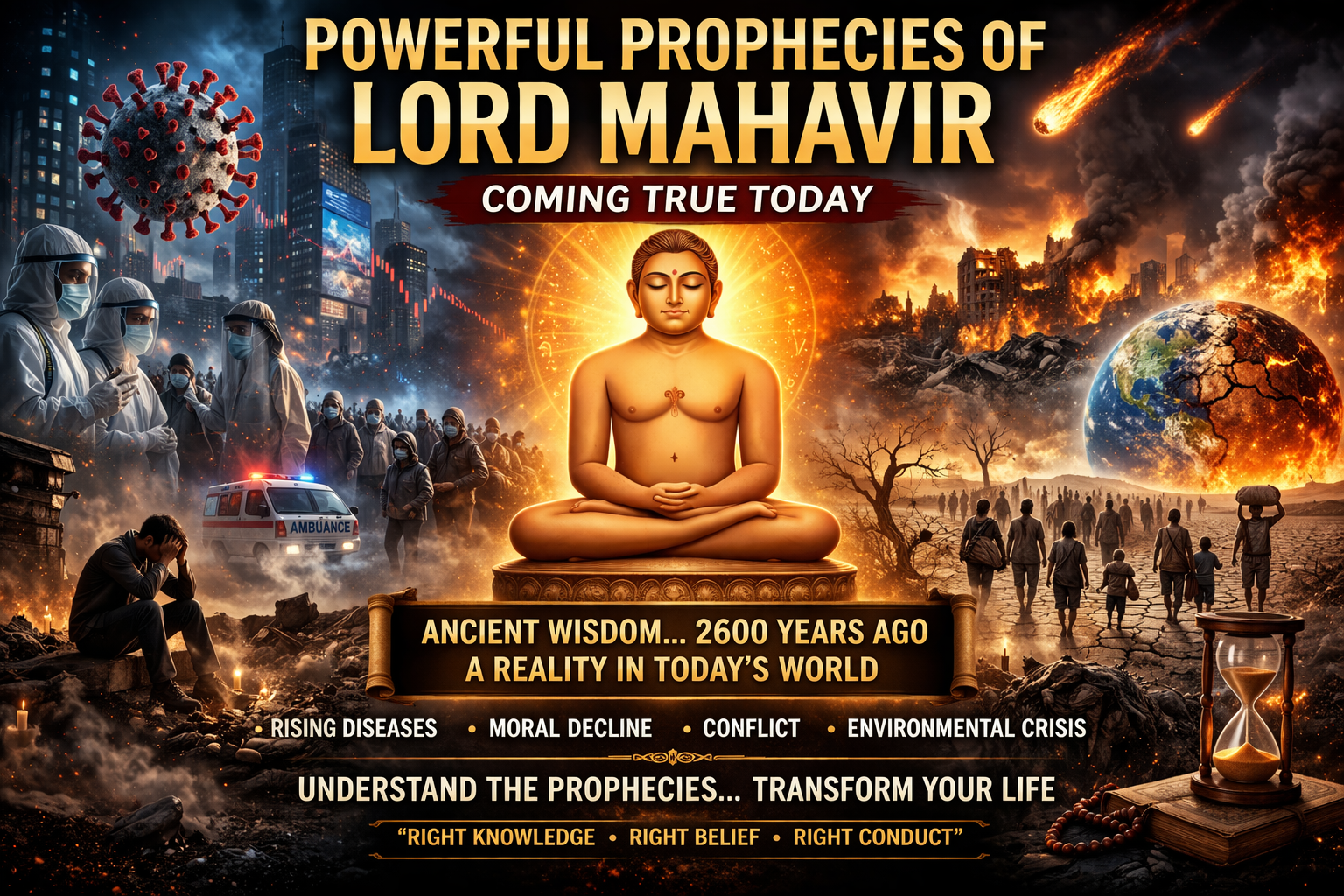
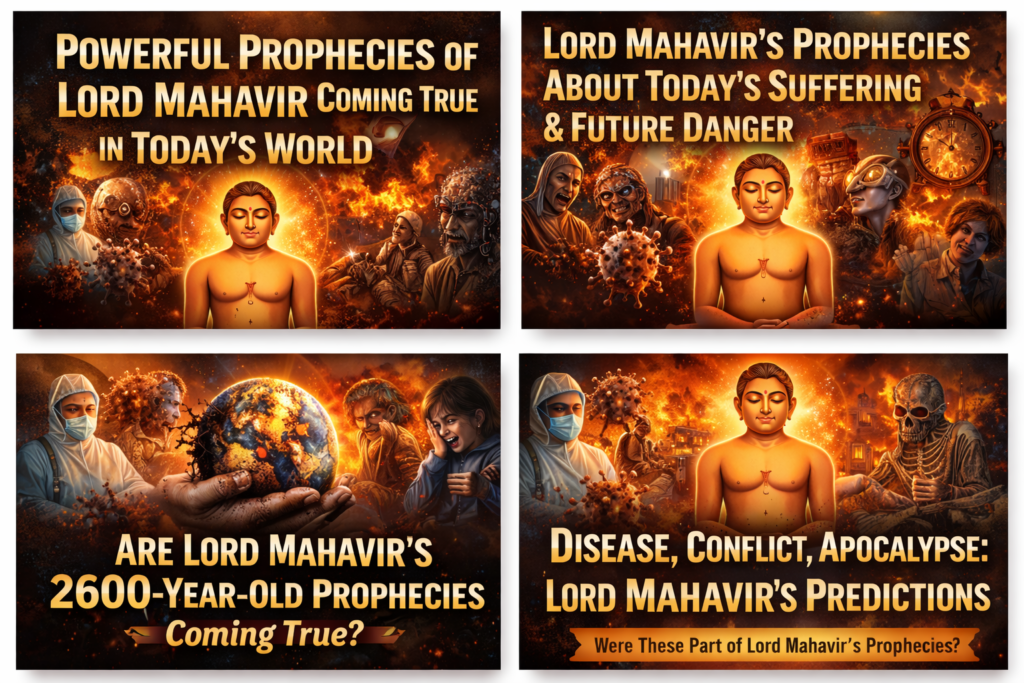
What if I told you that the Powerful Prophecies of Lord Mahavir, made over 2600 years ago, are coming true now- right in front of your eyes? From rising diseases in every household to increasing conflicts and moral decline, the world today looks exactly like what was predicted centuries ago by Lord Mahavir.
The Powerful Prophecies of Lord Mahavir are gaining attention in today’s world as humanity faces uncertainty, holocaust, bizarre diseases and moral decline. As time moves forward, people are becoming more curious about the future. The recent global crisis has made everyone question what lies ahead. So, are these just coincidences – or are we truly living in the time that was foretold?.

POWERFUL PROPHECIES Of LORD MAHAVIR AND THE COSMIC TIME CYCLE:
To understand the powerful Prophecies of Lord Mahavir, we must first understand the concept of the cosmic time cycle in Jain philosophy. Cosmic Time cycle is divided into two phases, and each phase is divided into 6 eras:
❖ AVASARPINI ( the descending phase)
❖ UTSARPINI ( the ascending phase)
Currently, we are in the 5th era of Avasarpini phase, a time marked by sufferings and decline in human values. Lord Mahavir was born in the 4th era of Avasarpini phase and attained liberation at the start of the 5th era. This era (i.e) the 5th era of Avasarpini phase will last for21,000 years, which means the world is not ending soon.
POWERFUL PROPHECIES OF LORD MAHAVIR VS MODERN PREDICTIONS:
In today’s world, predictions about the future are everywhere – ranging from global destruction and deadly pandemics to wars, technological threats and the end of humanity. Many people often refer to famous predictors like Nostradamus and Baba Vanga, whose forecast has gained attention for aligning with certain global events.
However, the Powerful Prophecies of Lord Mahavir offer a much deeper and more timeless perspective. He emphasized that:
❖ Every soul shapes its own destiny through KARMA.
❖ Suffering is not accidental – it is self – created.
❖ Happiness is not gifted – it is earned through actions.
In a world full of chaos, stress and uncertainty, Lord Mahavir’s teaching reminds us that our present action determined our future reality. The message is very clear – Change your actions and you change your life. But, seeing today’s rise of materialism and decline of morality, Lord Mahavir foresaw a time when:
● Material wealth world overshadow spiritual wisdom
● People would chase pleasure over purpose
● Truth and Compassion would be ignored
And look today around – this prophecy is unfolding. Society is driven by comparison, greed and instant gratification. Yet, lord Mahavir warned that this path leads to inner emptiness and suffering, not fulfillment.
A POWERFUL PROPHECY OF LORD MAHAVIR THAT IS ALREADY TRUE:
One of the most powerful Prophecies of Lord Mahavir states that every household will suffer from any form of diseases. This is clearly visible today. Diseases like:
★ Heart disease
★ Blood pressure (BP)
★ Diabetes
★ Mental stress
★ Cancer
Almost every house is dealing with some form of illness. This Prophecy, made 2600 years ago is now a reality.

POWERFUL PROPHECIES OF LORD MAHAVIR ABOUT THE 6TH ERA:
➢ The two most important pillars of human life will not be there in the 6th era –RELIGION and EDUCATION.
➢ After the 5th era completes, fire rain will destroy all life’s.
➢ Humans will be like dwarfs and the age will not be more than 20 years in the 6th era.
➢ Extreme heat during the day and extreme cold at night.
➢ Aquatic creatures or cave – dwelling creatures will be hunted, cooked and baked in the extreme hot temperature at day time and eaten during the night.
➢ Mutual clashes wretched, no moral values, insensitive behaviour towards opposite gender, non- ethical, weak, lean – this will be the behaviour of a human in 6th era.
➢ Relationships will lose meaning.
➢ The 6th era will be full of only and only sorrows.
Many of these Prophecies are already beginning to appear in today’s world.
TEACHINGS BEHIND THE POWERFUL PROPHECIES OF LORD MAHAVIR:
The Powerful Prophecies of Lord Mahavir are not meant to create fear – in fact, they guide us towards a better life. He showed a path to overcome suffering:
THE THREE JEWELS TO BE ACHIEVED:
★ Right Knowledge
★ Right Belief
★ Right Conduct
THE THREE PILLARS TO BE WORSHIPPED:
★ God
★ Guru
★ Religion
SHOULD CONDUCT THE THREE RELIGIONS:
★ Non – violence
★ Patience
★ Tenacity
CONCLUSION:
The Powerful Prophecies of Lord Mahavir are not warnings meant to create fear – they are timeless truths meant to awaken us. What we see today like rise in diseases, emotional struggles and weakening human values – was already foreseen thousands of years ago by Lord Mahavir. This is not the end of the world, but an era of transformation in the cosmic cycle.
The real question is not, what will happen next – it should be “how we choose to live in these times”. If we continue to drift with negativity, suffering will grow. But if we follow the path of right Knowledge, right Belief and right Conduct, we can rise above the darkness of this era. In the end, the powerful Prophecies of Lord Mahavir don’t predict our fate, they guide us to change it. He revealed a powerful truth to the world – “You are the Creator of your own Destiny and the Architect of your own Liberation”.
REFERENCE :
https://share.google/292D1L3NbZeJomirK
REFERENCES:
https://sumermannwings.com/jain-vision/
https://sumermannwings.com/the-truth-of-life-and-soul/
https://sumermannwings.com/emotional-intelligence-superpower-guide/
<!– wp:post-terms {“term”:”post_tag”,”prefix”:”Powerful Prophecies of Lord Mahavir\u003cbr\u003eLord Mahavir Prophecies\u003cbr\u003eMahavir Predictions\u003cbr\u003eJainism Prophecies\u003cbr\u003ePredictions That Came True\u003cbr\u003eShocking Ancient Predictions\u003cbr\u003eSpiritual Awakening\u003cbr\u003eTruth of Life\u003cbr\u003eMoral Decline in Society\u003cbr\u003eHuman Suffering Meaning\u003cbr\u003ePath of Liberation\u003cbr\u003eJain Philosophy \u003cbr\u003eAncient Predictions Coming True\u003cbr\u003eFuture Predictions About World\u003cbr\u003eSpiritual Predictions\u003cbr\u003e”} /–>
Unmasking the illusion of identity and the truth of the soul:
The Truth of Life and Soul Begins with a Question :
The Truth of Life and Soul is not something we are taught—it is something we quietly search for throughout our lives.We believe we know who we are. We carry names, identities, roles, and responsibilities with confidence. But deep within, a question still remains unanswered—is this really who I am?
Who are we beyond this body? Why are we here? What is the purpose of our existence?Some ignore these questions. Some avoid them. And some never dare to ask. But the moment we begin to question, we step closer to something deeper—something real. Because the truth is, until we understand the truth of life and soul, we are not truly living… we are only playing our part in a world we barely understand.
The Truth of Life and Soul Beyond Identity :
The world around us is divided in many ways—by gender, roles, professions, beliefs, and identities. Some become engineers, doctors, or leaders. Others dedicate their lives to family, business, or service. But who decided these roles for us? And more importantly—do these roles define who we truly are?
As William Shakespeare once said, “All the world’s a stage.”If that is true, then we are nothing but actors—playing roles, wearing identities, and eventually exiting the stage. Each human is born with something unique. Yet, despite this uniqueness, we fight. We hurt. We divide ourselves through religion, caste, status, and ego. We chase happiness, often at the cost of others… Why?

The Truth of Life and Soul Through Karma :
To understand this, imagine a conversation—not between God and a human, but between a human and the soul.
HUMAN : If all the bad or good things are done by me, then it would have been destroyed with my body, at the time of my death…. am I correct..??
SOUL : No, whatever you do, whether good or bad, everything will be calculated. This process is called “KARMA”. At the time of your death, only the body is destroyed, not the soul.
The Truth of Life and Soul and the Role of the Soul :
HUMAN : So, whatever good or bad things are done, it is done by the soul and not by the body..?? Then, why does the so called KARMA suffers the human body..?
SOUL: Soul doesn’t do any good or bad deeds. It is pure, eternal. All goods and bads are done by humans.
HUMAN : Why..??
SOUL : No matter how smart, talented or clever a human is, unless he produces peaceful reforms through his feelings, the outer substance won’t give you minimal happiness. The soul should be filled with 12 feelings everyday in life, so that in any situation the human will not be sad and does not tie bad karma’s.
HUMAN : Even after the soul is filled with 12 feelings, the humans behave very badly like jealousy, ego, hurting, harming, killing, revengeful behaviour, differentiating human from human, making boundaries, and etc…
The Truth of Life and Soul in Our Upbringing :
SOUL : I totally agree with you… All the above said things happen and are done by humans, but not because of the feelings, but because of what we see, we learn…!!! When a new child is born, he/she doesn’t know his name or religion. He/she is like a plain paper, and his family fills the paper as per their culture, sacraments.
HUMAN : So, all our deeds are because of our ambience. But ,we are the ones who earn money, resources and offer money, resources to God, so that he will be happy and in return give us prosperity, blessings and rinse off all the hurdles.
SOUL : About which money and resources are you talking…??? Did you see, any God took your offerings with him..? Even humans can’t take anything with themselves and you are talking about the offerings made to God…
The Truth of Life and Soul vs Material Illusions :
HUMAN : Don’t talk as and how you wish…?? We, the humans, offer money in ways of diamonds, pearls or gold jewelry / ornaments..
SOUL : But all this jewelry made of gold, diamonds or pearls are not pure, immortal or unused.
HUMAN : What do you mean..???
SOUL : I mean these things have already been used by someone or else it is like the leftover from the above things. For example, If I offer gold, it has already been used by the soil. If I offer Diamond, it has also been used by coal. In the same way for pearls, they have been used by the concha( shell)…
HUMAN : We even offer many resources to God like fruits, flowers, milk, sandalwood. They are so pure. These items have not been used by anyone.
SOUL : Do you know, from where the flowers and fruits are taken as an offering..?
HUMAN : Plants and trees..
SOUL : And who sits on plants and trees..??? Birds and bees… Then how flowers and fruits are unused. About milk I can say, everyone knows milk is obtained from a cow, who has just delivered her baby. And you are all using that milk for God as offering which is actually to be used by the calf. Then how milk is pure. Sandalwood also, has been already used by snakes.

HUMAN : oohhh.. So, like whatever money or resources we are offering are of no use..
SOUL : I said, they all are not pure.
HUMAN : Then, what can I offer, my mind, my body…??
SOUL : Your body has already been used by your spouse and your mind has also been used by the attachment for kids, luxury, wealth, family etc…. so they are also not pure.
HUMAN : Now I feel so poor. But wait, I have my religion, that is pure and eternal. I’ll offer my religion to God.
SOUL : Religion, Caste, Community a person gets according to his/her KARMA. The acts or the deeds done by humans designates the caste, community and religion. So, if you offer religion to God, it is just like the leftover of your acts.
The Truth of Life and Soul and Purity :
HUMAN : Ohh..!! All this time I thought that money and resources are those sources through which we can pamper God and in return HE will bless me with prosperity, wealth and happiness. But I was wrong. Wealth, resources can give happiness only to those for whom money and resources are the priority and not the relationship. Now, I feel so down that I can’t find a solution to this problem. What can I give as offerings to God?
SOUL : What can I say…??? I showed you the path, now you have selected your way and walked on it.
REFERENCE:
https://share.google/XFaHrbH6zjl1w0gw3
REFERENCES :
https://sumermannwings.com/soul-and-enemies/
https://sumermannwings.com/aura-the-human-spirit/
https://sumermannwings.com/karma-a-journey/
The Truth of Life and Soul as the Highest Offering :
HUMAN : Ok,, then, which is the most purest and eternal thing which I can offer to God. Is it you..??? Because you’re pure, eternal. Yes., you are the only element that is pure and eternal. I am so stupid, I searched here and there, in money, resources, for what can I offer to God, in order to pamper HIM and get, in return, happiness, prosperity, success and blessings. But, the real happiness, prosperity is in us, the pure soul, which is in our body. If I’ll offer my soul to God, that is the best offering made to HIM by HIS devotee.
The Truth of Life and Soul – The Final Truth:
We spend our lives searching—in people, in wealth, in religion, in the world. But the truth was never outside. The Truth of Life and Soul has always been within us. We are not just bodies living in the world—we are souls experiencing life. And the moment we realize this, everything changes.
<!– wp:post-terms {“term”:”post_tag”,”prefix”:”the truth of life and soul\u003cbr\u003emeaning of life\u003cbr\u003esoul and karma\u003cbr\u003epurpose of life\u003cbr\u003espiritual awakening\u003cbr\u003eself realization\u003cbr\u003einner peace\u003cbr\u003ehuman existence\u003cbr\u003etruth about life\u003cbr\u003elife and spirituality\u003cbr\u003ewhat is the true meaning of life and soul\u003cbr\u003eunderstanding karma in human life\u003cbr\u003ehow to find inner peace and purpose\u003cbr\u003ekarma and actions\u003cbr\u003esoul vs body\u003cbr\u003etrue identity of human\u003cbr\u003espiritual journey\u003cbr\u003ephilosophy of life\u003cbr\u003e”} /–>
Why is learning skills that will be in demand in next 5 years is Important..?
With rapid advancements in technology, automation and artificial intelligence, the job market is changing faster than ever. Many traditional jobs are disappearing, while new opportunities are emerging that require completely different abilities. If you want to stay relevant, you must learn the skills that are in demand in next 5 years. In this article, you will discover the most important future skills you should start learning today to secure your career and income.
Why does learning Future Skills Matter..?:
The job market is evolving faster than ever. Automation, artificial intelligence and digital transformation are reshaping industries. According to industry trends, many current jobs may disappear. But new roles will emerge that require advanced and adaptable skills. So, the question is – Are you preparing for the future or falling behind?
Top Skills That Will Be In Demand In Next 5 Years:
Over the next five years, the most in – demand skills will blend advanced technology with human centric abilities, specifically, generative AI, data analysis, cybersecurity and cloud computing. To complement these, professionals must master adaptability, critical thinking and digital storytelling. Here are the top skills projected for the next 5 years.
TOP TECHNICAL SKILLS THAT WILL BE IN DEMAND IN NEXT 5 YEARS:
Artificial Intelligence (AI) and Machine Learning (ML) :
AI has moved beyond experimental projects. It is now integrated into everything from personalised health care diagnostic to marketing to fraud detection in the banking system i.e. completely transforming everything. Companies are actively hiring people who understand AI tools and systems.
Why Skills are in Demand in Next 5 Years Matters:
➔ Workers with AI skills and expertise have salary hikes of over 54%, enjoying the highest pay. It has high paying opportunities.
➔ Companies across industries and all sectors are desperate for hiring AI talent.
➔ The AI market continues its explosive growth trajectory as it is a future- proof skill.
How to Learn Skills That will be in Demand in Next 5 Years:
❖ Learn basics of AI and ML.
❖ Take beginner friendly online courses.
❖ Explore tools like Chat GPT, automation platforms.
❖ Google cloud professional machine learning engineer.
❖ Microsoft Azure AI engineer associate.
Data analysis and data science:
Data is the new oil. Companies rely on data to make smarter decisions. Every business generates huge data but only few can actually make use of it. This is the place where data scientists enter. From e-commerce platforms optimising prices to agricultural companies prediction crop yields, data-driven decisions are making or breaking the business.
Why Skills Are in Demand in Next 5 Years Matter:
➔ There is a very high demand for data scientists in India as well as in the global market from health care to entertainment.
➔ India’s data analytics industry continues rapid expansion.
➔ Data scientists are valuable in every industry and they are paid with excellent salary packages.
How to Learn Skills That will be in Demand in Next 5 Years:
❖ Excel / Google sheets.
❖ Structured Query Language ( SQL).
❖ Data visualization.
❖ Applied data science with Python.
❖ Google data Analytics professional certificate.
Cyber security and Ethical Hacking:
Cyber security is the broad practice of protecting systems, networks and data from digital attacks and Ethical Hacking is a specialised, proactive subfield within it. As the digital footprints expand, Cyber threats multiply. The need to protect sensitive data and crucial infrastructure has made cybersecurity one of the most important and recession – proof fields.
Why Skills Are in Demand in Next 5 Years Matter:
➔ Cyber threats don’t stop during economic crises.
➔ The talent shortage is severe and the situation is getting worse.
How to Learn Skills That will be in Demand in Next 5 Years:
❖ Certified Ethical Hacker from EC- Council, penetrates testers, security analyst.
❖ Comp ITA security+
❖ Understanding of operating systems ( Linux / Windows); programming languages and security protocols.
❖ Demand in sectors like finance, defence and Tech.
❖ CISSP – Certified Information System Security Professional.
UI / UX Design:
A UI / UX designer creates functional appealing digital interfaces by combining user research ( UX) with visual design (UI). The focus is on user needs, wire framing, prototyping and testing to ensure intuitive experiences. Good design = better use experience; that is why UX / UI designers are valued.
Why Skills Are in Demand in Next 5 Years Matter:
➔ It is a creative + technical field.
➔ UX designers are creators with skills.
➔ UI designers are technical with skills.
➔ High demands in start-ups and tech companies.
How to Learn Skills That will be in Demand in Next 5 Years:
❖ User psychology
❖ Design tools ( Figma, Adobe XD)
❖ Wire framing.
Digital marketing:
Digital marketing is the promotion of brands, products or services using online platforms, electronic devices and internet-based technologies. It enables data-driven, cost effective outreach compared to traditional marketing. Companies are fighting fierce battles for online visibility, making skills in SEO, social media marketing and data-driven campaigns essential.
Why Skills Are in Demand in Next 5 Years Matter:
➔ Every business needs customers and today everyone is online.
➔ Digital marketers can work from anywhere, and so are in constant demand.
➔ Great for starting your own business.
➔ High freelance opportunities.
How to Learn Skills That will be in Demand in Next 5 Years:
❖ Search Engine Optimization (SEO).
❖ Content marketing.
❖ E-mail marketing and marketing automation.
❖ Pay-per-click (PPC), advertising on Google and other social media platforms.
❖ Social media marketing and growth.
❖ Google Ads certification.
❖ SEMrush academy certificate.
❖ Meta blueprint certification.
COGNITIVE AND SOFT SKILLS:
Critical Thinking and Problem Solving:
Not all skills are technical. Companies even need people who can think, adapt and solve problems. Critical Thinking is the objective analysis and evaluation of information to form a reasoned judgement, while Problem Solving is the process of implementing solutions to overcome obstacles. Together they get involved in defining issues, analysing data,identifying the biases and acting decisively to achieve goals.
Why Skills Are in Demand in Next 5 Years Matter:
➔ Essential for navigating complex situations such as Managing.
➔ Without Critical Thinking, solutions may be ineffective.
➔ Without Problem Solving, analysis remains purely theoretical.
➔ To understand the root cause of a problem.
➔ Together or separately it helps in any career.
➔ Makes you stand differently.
➔ It is hard to replace with AI.
How to Learn Skills That will be in Demand in Next 5 Years:
❖ Coursera Critical Thinking course.
❖ Solving Problems with Creative and Critical Thinking – IBM
❖ University backed certificate.

Emotional Intelligence (EQ) and Human Centric Abilities:
Despite the rise of automation, Human Centric Abilities are irreplaceable. Emotional intelligence includes Self – Awareness, Empathy and strong Communication will set professional apartment. As remote work and cross – cultural teams become more prevalent, these interpersonal abilities like leadership, communication, adaptability, and collaboration are increasingly more valuable and drive long – term career growth.
Why Skills Are in Demand in Next 5 Years Matter:
As AI handles technical tasks, the skills that can’t be automated, like –
➔ Understanding your own emotions.
➔ Managing stress and reactions.
➔ Empathize with others.
➔ Communicate effectively.
➔ Building relationships.
➔ Leading teams.
➔ Creative problem solving.
How to Learn Skills That will be in Demand in Next 5 Years:
❖ Effective communication – Join toastmasters club for public speaking and communication.
❖ Practice active listening in every interaction.
❖ Take leadership and management courses on LinkedIn learning.
❖ Volunteer for cross – functional projects.
BONUS FAST GROWING SKILLS THAT WILL BE IN DEMAND IN NEXT 5 YEARS:
Entrepreneurship and Business Skills:
More people are choosing this skill to start their own businesses or side hustles. This skill matters as it provides financial freedom, creative freedom and unlimited earning potential.
Cloud computing:
The migration to cloud infrastructure is not coming, it has already happened. It is a demand delivery of IT resources such as servers, storage, data base and software – over the internet with pay – as – you – go pricing. Instead of buying and maintaining physical data centres, users access technology services on an as needed basis from providers like AWS, Google cloud, Microsoft Azure. Businesses now rely on cloud computing for security, scalability and cost efficiency.
Blockchain technology:
Blockchain is revolutionising way more than just Cryptocurrency. It is a decentralised database or ledger that securely stores records across a network of computers in a way that is transparent, immutable and resistant to tampering. It “block” contains data and the blocks are linked in a chronological chain and hence creating entirely new paradigms for trust in digital transactions.
Renewable energy and green technology:
India marches towards its ambitious climate goals. Renewable energy and green technology focus on using naturally replenished – solar, wind, hydro, geo thermal- to generate sustainable heat and electricity while minimizing environmental impact. Driven by decarbonisation goals, technologies like Solar PV and wind are expanding rapidly, reducing reliance on fossil fuels and driving significant economic growth and job creation.
Your 6 month plan to learn skills that will be in demand in next 5 years:
➔ Pick one skill based on your interest.
➔ Use free platforms ( blogs , courses,YouTube).
➔ Practice consistently.
➔ Build small projects .
➔ Stay updated with trends.
➔ Network actively in your target industry.
➔ Share your work and start applying.
REFERENCE:
https://share.google/bfzmbS5XD604XEluJ
REFERENCES:
https://sumermannwings.com/emotional-intelligence-superpower-guide/
https://sumermannwings.com/emotional-spending/
Conclusion:
The future is not something you wait for – it’s something you prepare for. The skills that will be in demand in next 5 years are not just about technology – they are a combination of technical expertise and human abilities like emotional intelligence, critical thinking and communication.
Don’t wait for the perfect time. Start today, build consistently and become the person the future needs because – the future doesn’t belong to the smartest person – it belongs to those who are willing to learn, adapt and take action.
<!– wp:post-terms {“term”:”post_tag”,”prefix”:”skills that will be in demand in next 5 years\u003cbr\u003efuture skills\u003cbr\u003eartificial intelligence\u003cbr\u003edata science\u003cbr\u003ecybersecurity\u003cbr\u003edigital marketing\u003cbr\u003ecareer growth\u003cbr\u003ecritical thinking\u003cbr\u003eemotional intelligence\u003cbr\u003eethical hacking\u003cbr\u003ecloud computing\u003cbr\u003efuture jobs 2026\u003cbr\u003eblockchain technology\u003cbr\u003efuture skills\u003cbr\u003ein-demand skills\u003cbr\u003eskills for future jobs\u003cbr\u003ehigh income skills”} /–>


