
Uncategorized
THE POWER OF KARMA – THE SECRET LAW THAT’S CONTROLLING YOUR LIFE RIGHT NOW


Why do good people suffer.?? Have you ever paused and wondered why life unfolds the way it does? Why do some moments bring unexpected joy, while others arrive as silent lessons wrapped in pain? Is it all just coincidence… or is there something deeper guiding every experience? The answer lies in the Power of Karma – an invisible force quietly shaping your journey with every thought, every word, and every action.
In the rush of modern life, we often chase instant success and quick happiness, forgetting that life doesn’t respond to wishes – it responds to actions. The reality you are living today is not co-incidence, it is a reflection of the energy you have created in the past, and the life you dream of? It is being built right now, through the choices you make in this very moment.
Is everything in life because of KARMA..? The most powerful truth is this: you are not a victim of fate, you are the creator of your destiny. Once you truly understand the Power of Karma, you begin to see that every small action holds the potential to transform your entire life.

WHAT IS THE POWER OF KARMA?:
What Is KARMA..?:
According to any religion, karma is the basic principle within a comprehensive psycho – cosmology. Human moral actions forms the basis of transmigration of the soul. Karma is identified as the relationship between a person’s mental or physical action and the consequences following that action. The spiritual principle of cause and effect which is often described as, “what goes around comes around”, impacting the current life and future reincarnations.
Understanding the law of cause and effect:
The law of cause and effect states that every effect (outcome/ event) has a specific cause and every cause (action/thought) has a specific effect, meaning nothing happens by chance. This law is also called the “iron law of the universe”. To understand this law, here are the key aspects of this law:
● It applies to all aspects of life, including health, relationships and financial success.
● Everything happens for a reason, whether good or bad.
● This law suggests if you want a different result (effect) you must change the action or thought (cause).
● People living “at cause” takes responsibility for their outcomes, while those “at effect”may feel like victims of circumstances.
Usage examples of UNIVERSAL LAW of CAUSE and EFFECT in Power of Karma:
| CAUSE | EFFECT | |
| 1. | studying and gaining new skills | career development |
| 2. | saving and investing money | financial independence |
| 3. | Rain | wet streets |
| 4. | consistent exercise and eating well | better physical health |
| 5. | Acting with Kindness and Empathy | fosters positive loving relationship |
Karma and Law of Cause and Effect :
Karma is the spiritual equivalent of the universal law of cause and effect, where every intention, thought and action serves as a seed (cause) that eventually matures into a corresponding experience (effect). Karma is effectively the cosmic law of “reaping what you sow”, ensuring that life is not random but a result of personal choices and actions.
THE POWER OF KARMA:
The power of Karma empowers individuals to shape their destiny through conscious, ethical choices, reinforcing personal responsibility rather than fatalistic resignation.
Key Aspects of THE POWER OF KARMA:
● The power of intention: Karma relies heavily on the motivation behind an action, a harmful intention creates a stronger negative karmic seed than an accidental action.
● The great law: Karma is not pre-determined, it is not a punishment or reward. It is a natural law stating that individuals create their own future by their actions, whatever energy you put into the world will return to you. If you put positive actions (kindness, compassion) leads to positive outcomes, while harmful actions create negative experiences.
● Instant vs delayed effects: While some consequences are instant, others take time to”ripen”, carrying over across days, years or even sometimes unfolding in future reincarnation.
● Reversing passed Karma: Understanding karma as cause-and-effect, allows that for personal transformation, by changing current actions, behaviour, thoughts and increasing awareness, one can shift the trajectory of their future i.e. breaking the cycle of negativity.
● System of Accountability: Often called the”law of cause and effect”, it ensures individuals face the outcomes of their deeds, acting as a guide for Ethical behaviour.
● Physical and mental realm: This law applies to both actions in the physical world (eg: touching a hot stove causes pain) and mental actions (eg: nurturing hatred causes unhappiness).
HOW THE POWER OF KARMA SHAPES YOUR LIFE:
Many people believe that life is controlled by luck or fate, but the truth is far more empowering. The power of Karma teaches us that we are the creators of our own reality. Karma shapes your life by acting as a universal law of cause and effect.

Keyways How Karma Shapes Your Life :
❖ When you act with kindness, you attract positivity.
❖ When you spread negativity, it returns in different forms like self-sabotaging patterns in relationships and success.
❖ When you work with honesty and dedication, success follows.
❖ When you fall into repeating patterns such as self – sabotage, consistent career challenges or toxic relationship loops – they are the reflections of unresolved “Karmic debt”.
❖ Karma will determine whether you live in a supportive environment or one filled with challenges.
❖ While past actions create situations, your present decisions allow you to shape your future. You are not the victim of fate, you are the designer of your destiny.
REAL LIFE EXAMPLES OF THE POWER OF KARMA:
★ Have you ever helped someone and later received unexpected support?
★ Have you noticed how negative thinking brings more stress and problems?
★ Have you seen how consistent efforts lead to growth and success?
These are not co-incidences, but the power of Karma in action. Life always responds to your energy.
HOW TO USE THE POWER OF KARMA TO TRANSFORM YOUR LIFE:
The most beautiful part about karma is you can change your life by changing your actions. Here are simple ways to create good karma:
1. Practice Kindness – Small acts of kindness create powerful positive energy.
2. Be Mindful of Your Thoughts – Your thoughts are the starting point of your actions.
3. Speak with Honesty and Compassion – Words have power, use them wisely.
4. Let Go of Negativity – Holding onto anger or jealousy only harms you.
5. Take Responsibility – Stop blaming fate, your actions shape your future.
THE DEEPER TRUTH ABOUT THE POWER OF KARMA:
The deeper truth about Karma is that it is not a system of cosmic punishment, revenge or rigid fate, but rather the neutral – impersonal law of cause and effect operating at a spiritual and psychological level. The core of Karma is not the action itself, but the intention behind the action which creates mental imprints that shape future experiences and character. Every action you take is like planting a seed. With patience and consistency, those seeds grow into the reality you experience.
CONCLUSION:
The most powerful truth you can understand is this that your life is not a matter of luck, it is a reflection of your actions. The Power of Karma reminds us that we are not helpless in this journey. We have the ability to shape our future through what we choose to think, say, and do every single day. So, if you want a better life, don’t wait for the world to change, start by changing your actions. Because in the end, the energy you give to the world is the life you create for yourself.
REFERENCE :
https://share.google/Kyb7AzWa9oXX28KRZ
REFERENCES:
https://sumermannwings.com/the-truth-of-life-and-soul/
https://sumermannwings.com/powerful-prophecies-of-lord-mahavir/
https://sumermannwings.com/jain-vision/
https://sumermannwings.com/karma-a-journey/

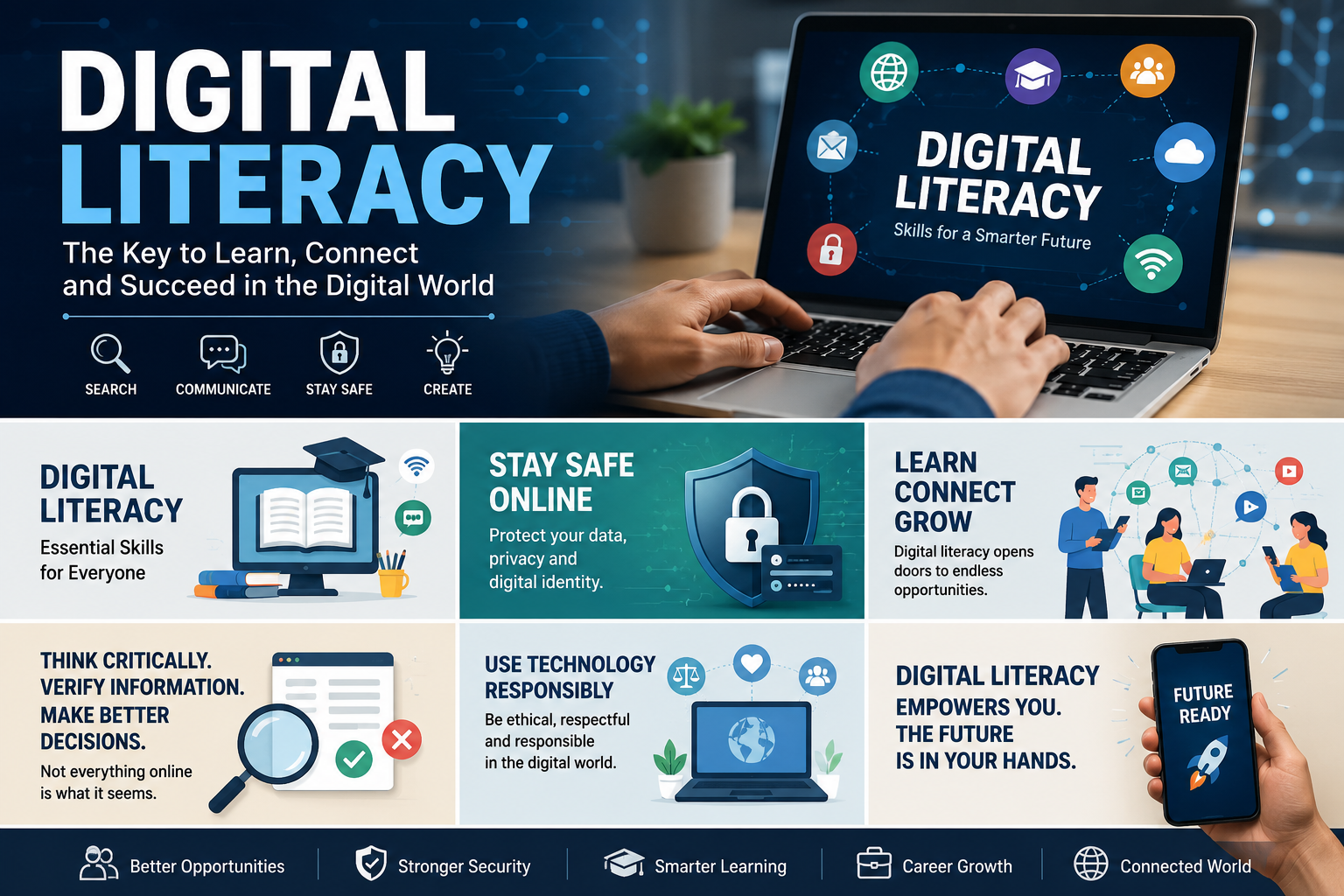
What Is Digital Literacy?:
Technology, Internet, digital world, information – these words are not new to us. Imagine you got stuck in a dream where you don’t know how to search information online, send an email, attend a virtual meeting, or protect your data. How you will react when you wake up or maybe I can say, what will be your first reaction?. Immediately you will check your phone, data, your meeting’s schedule – correct. So, basically in today’s digital world, where almost every task, from learning and working to shopping and communicating happens online, digital literacy has become one of the most important skills a person has to develop.
Digital Literacy is not about using computers or scrolling through social media. It is the ability to find reliable information, communicate effectively, stay safe online and use digital tools with confidence and responsibility. Developing digital literacy empowers individuals to adapt, grow and succeed in an increasingly connected world.
Why Is Digital Literacy Important in 2026?:
Digital Literacy as described by UNESCO, “the ability to use digital technology communication tools and networks to locate, evaluate, use and create information. It is the ability of an individual to understand and use digital technologies confidently and responsibly. It is also referred to as the basic skills or ability to use a computer safely and effectively. It includes the understanding to use contemporary software and digital tools or operate digital devices, access information, communicate effectively and protect personal data.
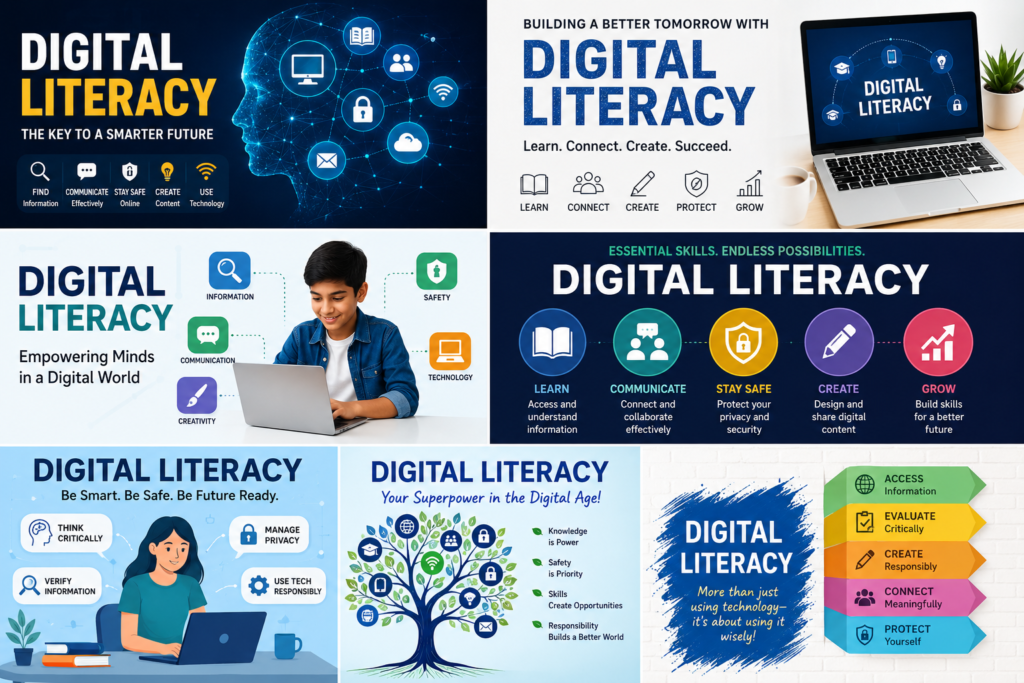
The knowledge to create, edit and present images, audio and video, using web browser and internet search engines and add in digital literacy. Being digitally literate also speaks more than simply using the internet, it helps making smart decisions in the digital environment. In 2026, digital literacy also includes awareness of AI, digital ethics and responsible use of emerging technologies.
Core Components of Digital Literacy:
The ability to critically evaluate, create and communicate information using modern digital technologies is digital literacy. Today, it requires AI fluency and cybersecurity awareness and the capacity to distinguish fact from AI generated misinformation.
AI Fluency: AI fluency understanding the algorithm biases, fact checking AI outputs and knowing how to write effective prompts to solve problems. In short, interacting with LargeLanguage Models (LLM).
Digital Privacy and Security: Privacy and Security includes understanding the foot print you leave after the work is done, utilising secure communication protocols and actively mitigating risks like cyber bullying and protecting personal data.
Critical Information Evaluation: Digital literate individuals know how to verify digital data and identify phishing attempts or online scams.
Real-Life Examples of Digital Literacy:
AI Tools: People use AI assistants to summarize information, generate ideas and improve productivity, avoiding overreliance.
Online Information: Individuals check sources, identify misinformation and recognise manipulated content such as AI generated.
Creating Digital Content: People create videos, blogs, podcasts and social media content while respecting digital ethics and copyright.
Financial Services: Digital Literacy includes safely using mobile banking, digital payments, wallet and also apps.
Data Privacy: Users review app permissions to manage private settings.
Digital Security: Digital security example includes enabling multi factor authentication, creating secure passwords, recognising phishing attempts and personal information.
Essential Digital Literacy Skills Everyone Should Learn:
Digital Literacy plays a vital role in our daily lives, enabling us to access information, communicate and use technology responsibly. Technology is no longer optional, it impacts how we work, communicate and navigate everyday life. From managing finances to social interaction, digital literacy empowers individuals to navigate the digital world and participate actively in personal, professional and educational activities.
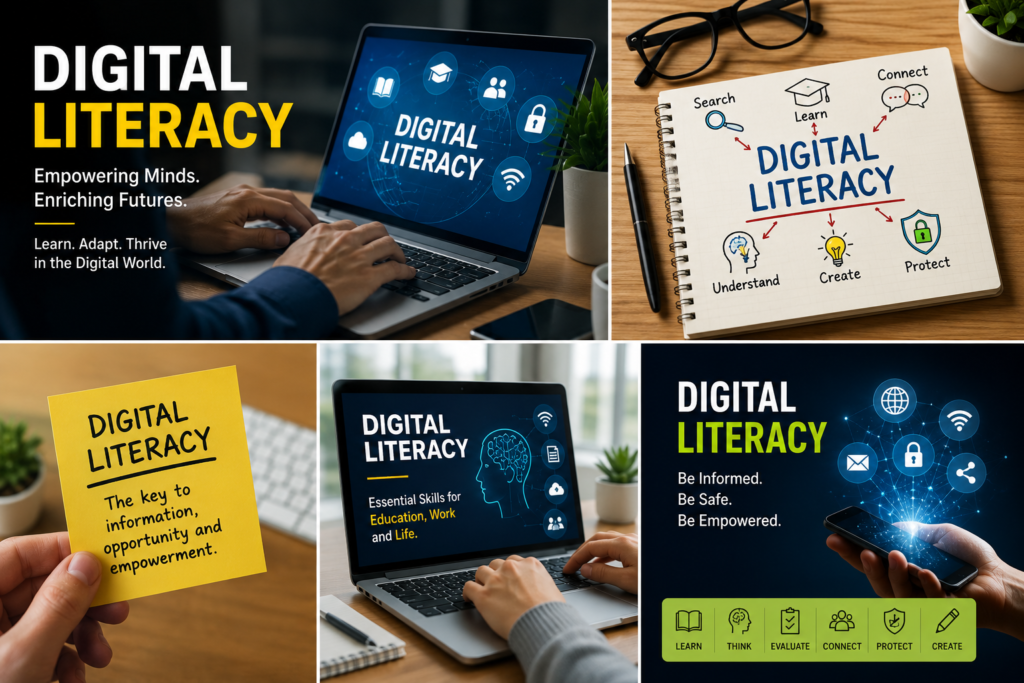
Why Digital Literacy Matters ?:
Top Benefits of Digital Literacy:
External References:
https://share.google/fKkMHSEoGzonB2dbA
https://share.google/wJTHlzTfGNj0HtlLx
You Can Also View:
https://sumermannwings.com/ai-and-future-skill/
https://sumermannwings.com/future-of-ai-search/
Common Challenges of Digital Literacy:
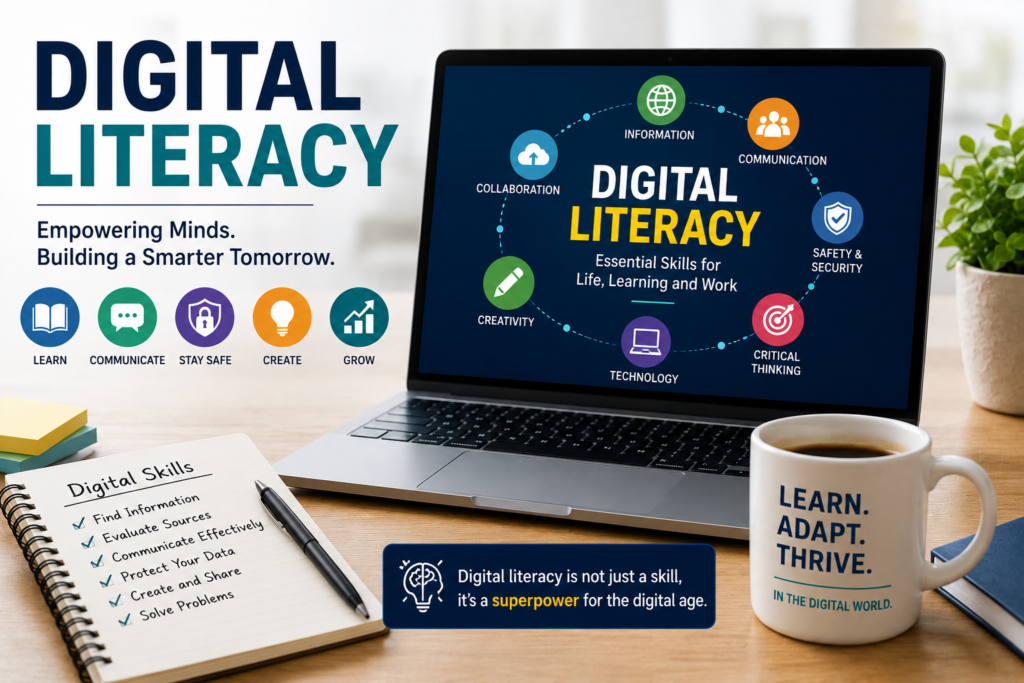
How to Improve Your Digital Literacy Skills:
Conclusion on The Future of Digital Literacy: AI, Ethics, and Emerging Technologies:
Introduction to AI and Future Skill:
Just imagine waking up in a world where robots assist doctors, smart machines drive cars, AI tools help students learn faster than before and computers can learn like humans. This future is no longer a dream, it is today’s reality created by AI and future skill. As the technology is growing in a rapid way, AI and future skill have become essential for students, workers and even for businesses too. Artificial intelligence continues to transform education, jobs and everyone’s everyday life.
Now, learning AI and future ready skill has become more important than ever before. From creativity and communication to coding and critical thinking, AI and future skill are shaping the path of success in the modern digital world. The ability to adapt, think creatively, and work alongside intelligent machines will only shape your career and opportunities for tomorrow.
What is AI and Why Future Skill Matter: Artificial Intelligence (AI) is the ability of machines and computers to think, learn, and make decisions like humans. Instead of just following the basic, pre-written commands, AI systems can learn from information, spot patterns, solve problems and make decisions. AI can analyze data, recognise speech and even create art and music. The tools which are popular AI tools are chatbots, virtual assistants, recommendation systems used by streaming platforms and even online stores. In simple terms, AI is a technology that gives computers and machines the ability to mimic human thinking.
AI and Future Skill in Everyday Life:
Examples of how we interact with AI everyday:
● While typing a text message, when you finish your sentence, correcting typos uses AI to guess what you mean to say.
● There are AI voice assistants in apps which we use everyday in life, who understands what you want to say and responds naturally.
● When streaming platforms like Netflix, YouTube suggest a movie or a show or any video you might like, AI is analysing what you have watched previously.
● Google maps, or any navigation apps helps in understanding real-time speed, and route data to find the fastest way to your destination.
How AI and Future Skill Are Changing the World:
The buzz around Artificial Intelligence lives up to the hypes. AI is changing the world faster than ever before. AI is gradually transforming how people interact with technology and is making considerable strides in healthcare, transportation, education, finance, marketing and more. As technology continues to grow, the future will demand new skills and knowledge. With the advancement in recent years, AI is transforming industries by creating intelligent machines that can perform tasks that typically require human intelligence.
In other words, AI is aiming to create machine that can think, learn and solve problems like humans. To achieve this goal, AI involves the development of algorithms and models that enable machines to perform cognitive tasks such as image and speech recognition, decision-making and natural language processing. Let’s see how AI is changing and preparing everyone of us for tomorrow’s world.
Automation of Tasks: AI automated many repetitive tasks like customer care, manufacturing, driving and even dangerous tasks that humans previously did with increased precision and added quality of work.
AI in Healthcare: AI has become a buzz word in the healthcare industry due to its potential of transforming it in many ways, from improving patient outcomes to reducing costs and enhancing the efficiency of healthcare delivery. AI is assisting doctors in diagnosing diseases in various ways which includes medical imaging analysis, monitoring and even scanning patient’s medical history and records.
With AI, it’s now possible to interpret mammograms at 99% accuracy without biopsies. AI algorithms analyse medical images like X-rays, MRI’s and CT scans to detect abnormalities and diseases. AI algorithms analyse patient data including medical history and genetic information. Even new treatments, surgical procedures and patient monitoring have also been improved.
AI in Entertainment: AI is increasingly used in the entertainment industry to create and upgrade content, personalize user experience and also improve efficiency. AI is used in various entertainment areas including music, movies, games and live events. AI-powered tools can analyze large amounts of data and generate the content based on the trends. Streaming services, for example, can use AI algorithms to recommend content to users based on their preferences and past watched history. AI can improve efficiency by making it more interactive.
Personalization at Scale: Shopping time gets shorter with AI. It recommends the items with its AI algorithms, suited to each shopper’s browsing profile in e-commerce.
Education and AI: AI has helped the education industry by creating personalized learning experiences for students by tailoring the lessons, assessments and materials, according to each student’s need and abilities. Adaptive learning platforms, virtual assistants and automated grading have made learning more enjoyable and efficient.
Agriculture and AI: By developing agricultural robots for crop monitoring, weeding, harvesting etc. AI will help in providing opportunities for robotic farming and agricultural technology providers.
New business models: Viewing from automobiles as risky to having self-driving cars, the business models with AI advancements like virtual assistants and robotics rides have enhanced customer experiences and set new standards in efficiency.
The Future of Technology: AI and Future Skill in 2034
The following is the advancement of AI in 2034-35.
Multimodal AI: The fledgeling field of AI with multimodal pattern as the aspect will be thoroughly tested and redefined in 2034. Unimodal AI focuses on a single data type, such as NPL or computer vision. In contrast to this multimodal pattern, AI more closely resembles how humans communicate by understanding data across voice, facial expressions, visuals and vocal inflection.
Multimodal AI is an Artificial Intelligence system that can process, understand and generate multiple types of data such as text, images, audio, video and even sensor data. It even includes intuitive interactions between human and computer systems too. Multimodal AI also has the potential to power advanced virtual assistants and chatbots that understand complex queries and can provide text, virtual aids and video tutorials in response.
Why Everyone Should Learn AI and Future Skill:
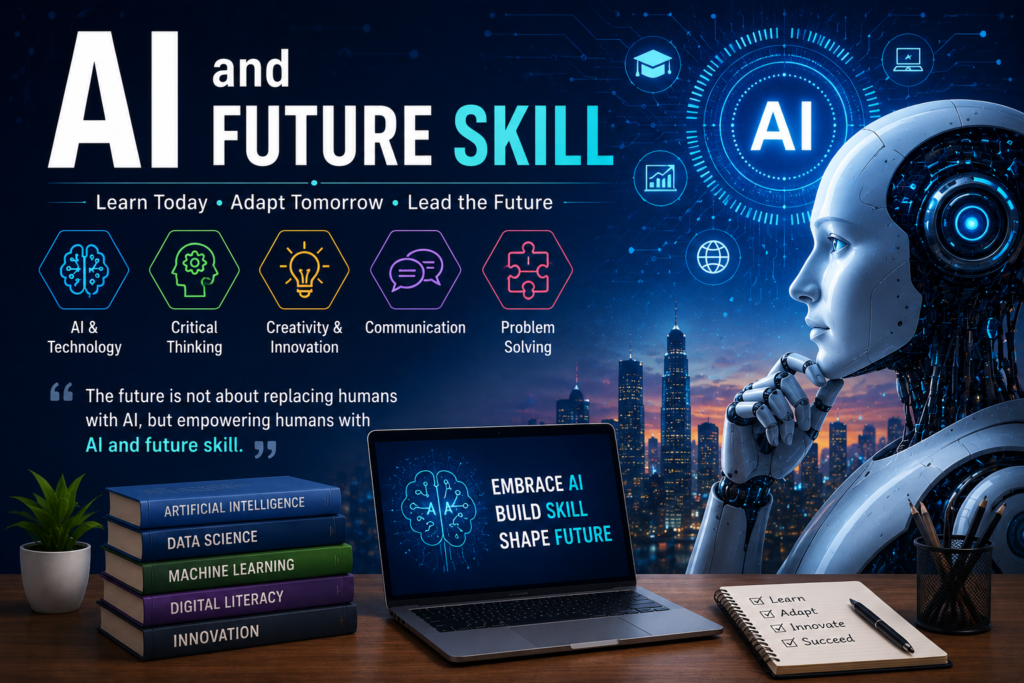
For 2026 and beyond to succeed in the future, everyone should develop their future ready skills. The top future skills focus on mastering AI and automation, data-driven decision making and human-centric soft skills. The following below skills will help people to work effectively with AI and modern technology:
Digital Literacy: Understanding the digital tools, internet and computers is essential. Basic knowledge of coding, software application, cyber security and ethical hacking will become increasingly important.
AI and Gen AI: Understanding and using AI tools like large language models, Python to automate tasks and improve efficiency.
Creativity and Innovation: Machines are human made which will follow human instructions and cannot be innovative or creative like humans. The uniqueness in human skills like designing, creative thinking, story telling, inventing will continue to be more valuable.
Emotional Intelligence and Adaptability: AI cannot understand emotions. Soft skills like Emotional Intelligence (EQ), Adaptability, empathy are more essential for managing and fostering collaboration.
INTERNAL REFERENCES:
https://sumermannwings.com/emotional-intelligence-superpower-guide/
https://sumermannwings.com/future-of-ai-search/
https://sumermannwings.com/skills-that-will-be-in-demand-in-next-5-years/
Communication skills: Good communication is a basic necessity in every field. People who are good at communicating their ideas and opinions clearly and can work well with others will have an advantage in the future work place.
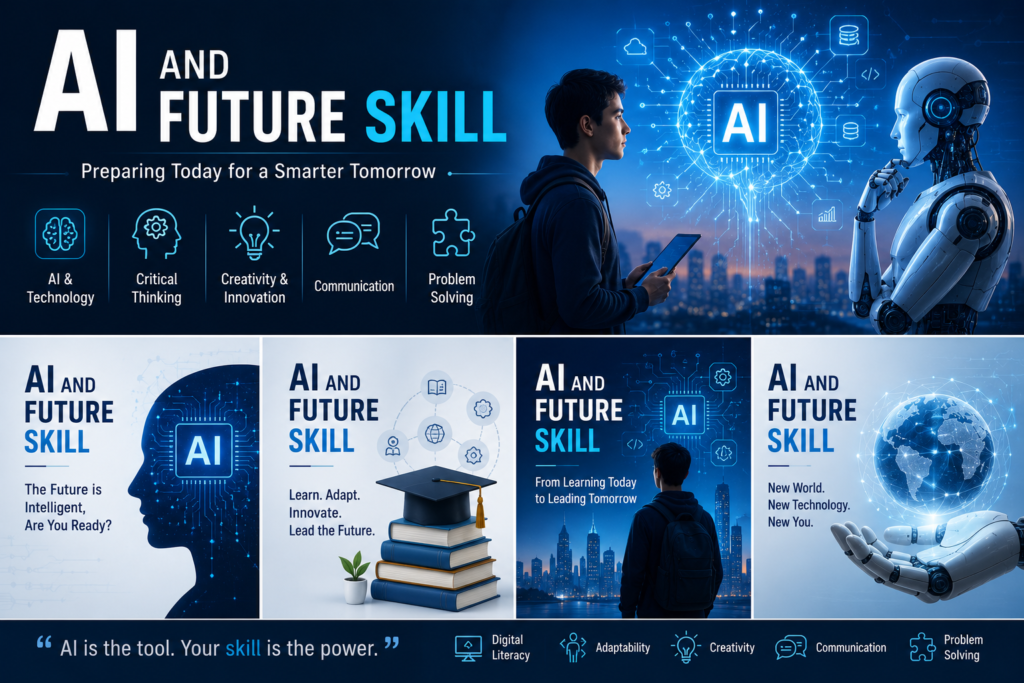
Future Careers Created by AI and Future Skill:
AI is driving rapid jobs growth across technical, strategic and human-centric sectors. AI is creating many new career opportunities. The fastest growing role focuses on building, managing and governing AI systems. Some future careers include:
❖ AI Engineer.
❖ ML and MLOps Engineers
❖ Prompt Engineer
❖ AI Architect and Consultant.
❖ Data specialist
❖ Robotics specialist
❖ Cyber security expert
❖ AI ethics specialist
❖ Digital marketing analyst
❖ Healthcare professional
❖ Educators and counselors.
How Students Can Develop AI and Future Skill: Students can prepare for the future by fostering adaptability, mastering digital literacy and honing critical soft skills like empathy and Emotional Intelligence. Cultivating a “life-long learner” mindset will help in navigating uncertainty and innovation.
★ Learn basic computer and coding skills.
★ Developing soft skills
★ Reading about new technologies
★ Mastering critical thinking and problems solving
★ Practicing creativity and teamwork
★ Taking online courses
★ Embracing life long learning
★ Improving communication skills.
REFERENCES:
https://share.google/Jx9GlZavSFP0uiegl
https://share.google/1rLGgKyDzrDNnArAq
Final Thoughts On AI and Future Skill:
To conclude, the world is moving towards a smarter and more digital future where AI and Future Skill will play a major role in everyone’s life. As Artificial Intelligence continues to grow, people must learn new skills to keep up with changing technology and future careers. Skills like creativity, communication, problem-solving, adaptability, and digital knowledge will help students and workers succeed in the modern world. By learning and improving AI and Future Skill, we can create better opportunities, build innovation, and confidently prepare for the future ahead.
<!– wp:post-terms {“term”:”post_tag”,”suffix”:”How AI is changing the future\u003cbr\u003eAI and future skills for students\u003cbr\u003eSkills needed for the future workplace\u003cbr\u003eFuture skills everyone should learn\u003cbr\u003eArtificial intelligence in education\u003cbr\u003eCareers in artificial intelligence\u003cbr\u003eGenerative AI\u003cbr\u003eMachine Learning\u003cbr\u003eInnovation and Technology\u003cbr\u003eCareer Development\u003cbr\u003eCritical Thinking\u003cbr\u003eCommunication Skills\u003cbr\u003eDigital Future\u003cbr\u003eLifelong Learning\u003cbr\u003eAI Careers\u003cbr\u003eEmerging Technologies\u003cbr\u003eAI and digital transformation”} /–>
Introduction to the Future of AI Search :
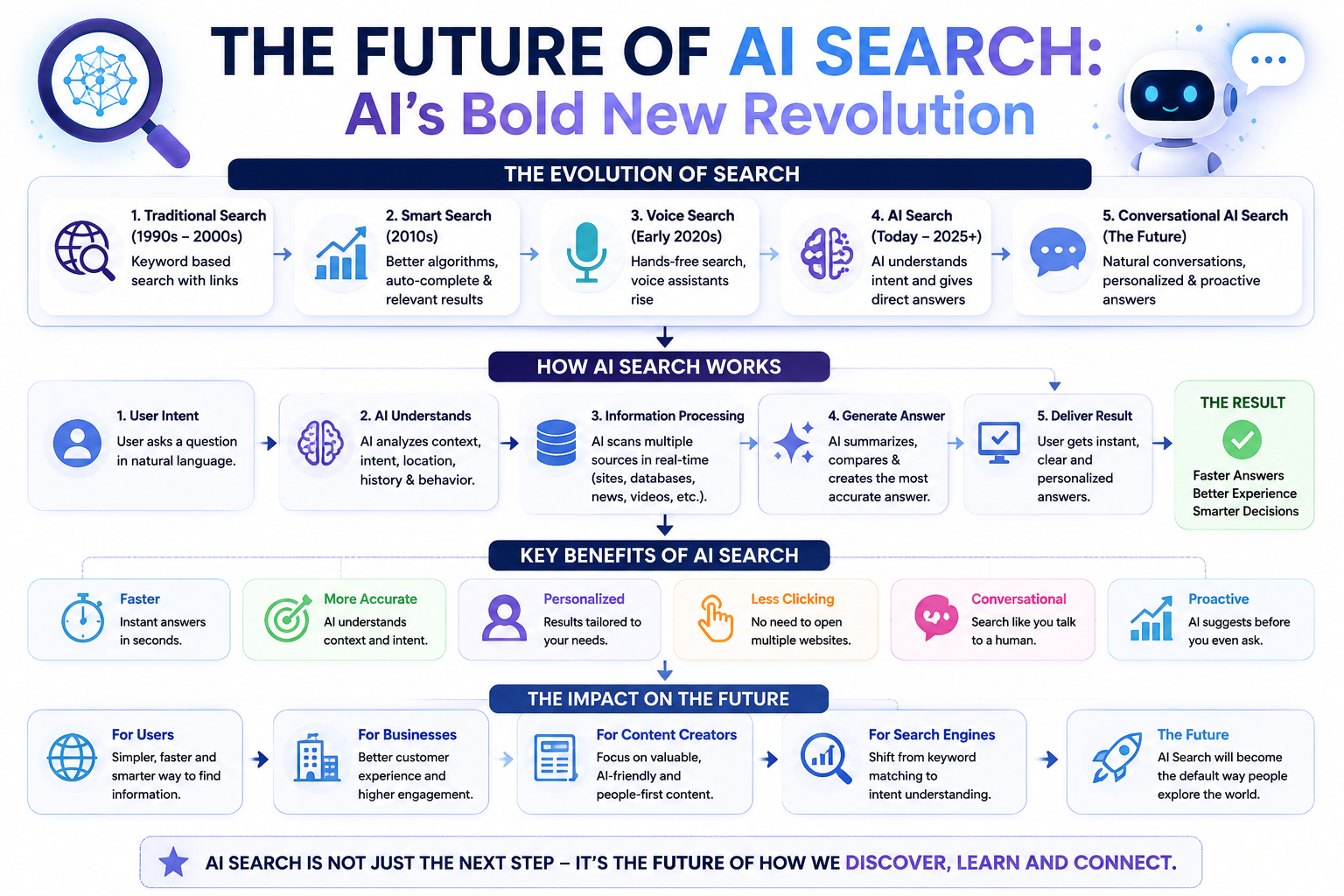
The future of AI search in the new era of the internet which is transforming the Internet faster than ever before. Now, Google search does not reply in the way of a list of blue links, but AI powered search results are transforming as AI gives results in the form of direct smart summaries, voice assistants and conversational answers online.
In the field of digital marketing, marketers, bloggers, website owners are analysing the change which is creating both challenges and opportunities to them. In this blog, we will understand how AI search is reshaping Google, because of which it has become more essential for everyone to survive in this modern digital era.
The Future of AI search:
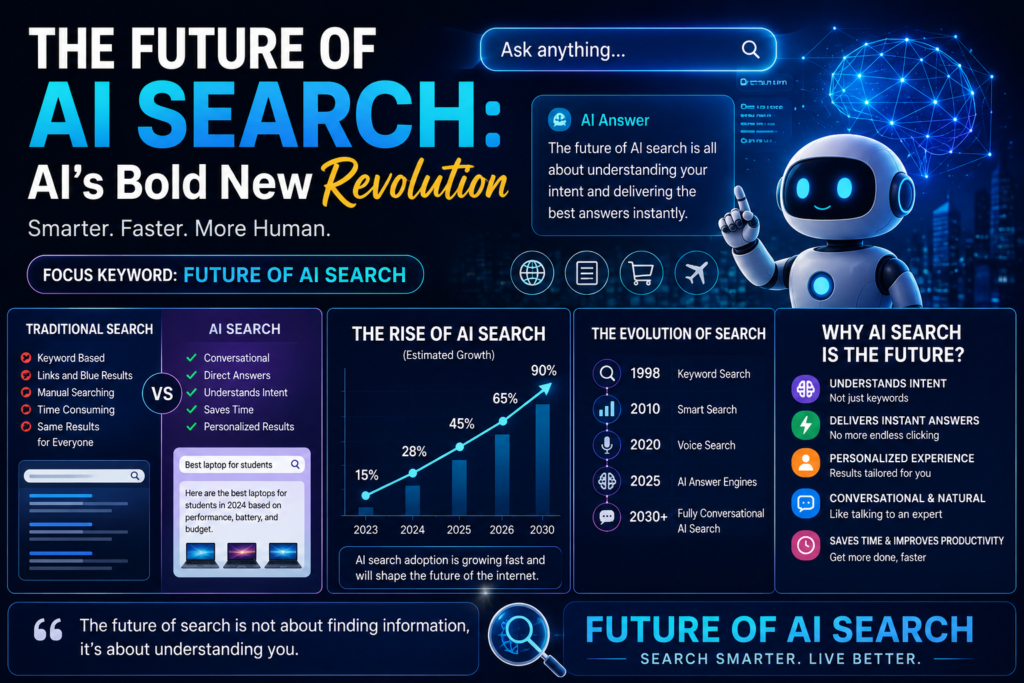
AI search is a modern digital way of getting information that not only understands the meaning behind your query, but also uses artificial intelligence as a knowledgeable assistant in analysing context to directly answer the questions of the users rather than just matching the keyword and listing the links and showing the websites. AI search tries to understand the meaning and intent behind the search.
Example for the future of AI search:
If someone searches for:“ Is Gold The New Investment God.?”
Google AI will instantly provides you the result as:
➔ The reality check between Gold vs Equities
➔ Why Investors flock to Gold
➔ The Recommended strategy for Gold
➔ How to invest in Gold.
How the Future of AI Search Is Replacing Traditional Search:
Google’s AI Search: This is one of the biggest changes in the history of AI, with the rise of Google AI Overviews, a tool of Google AI Search. Google AI Overviews, also known as AI mode or AI Overviews, is a feature where Google uses AI to read thousands of websites for you and summarizes the answer at the top of the results page, which gives quick answers to the queries of the users.
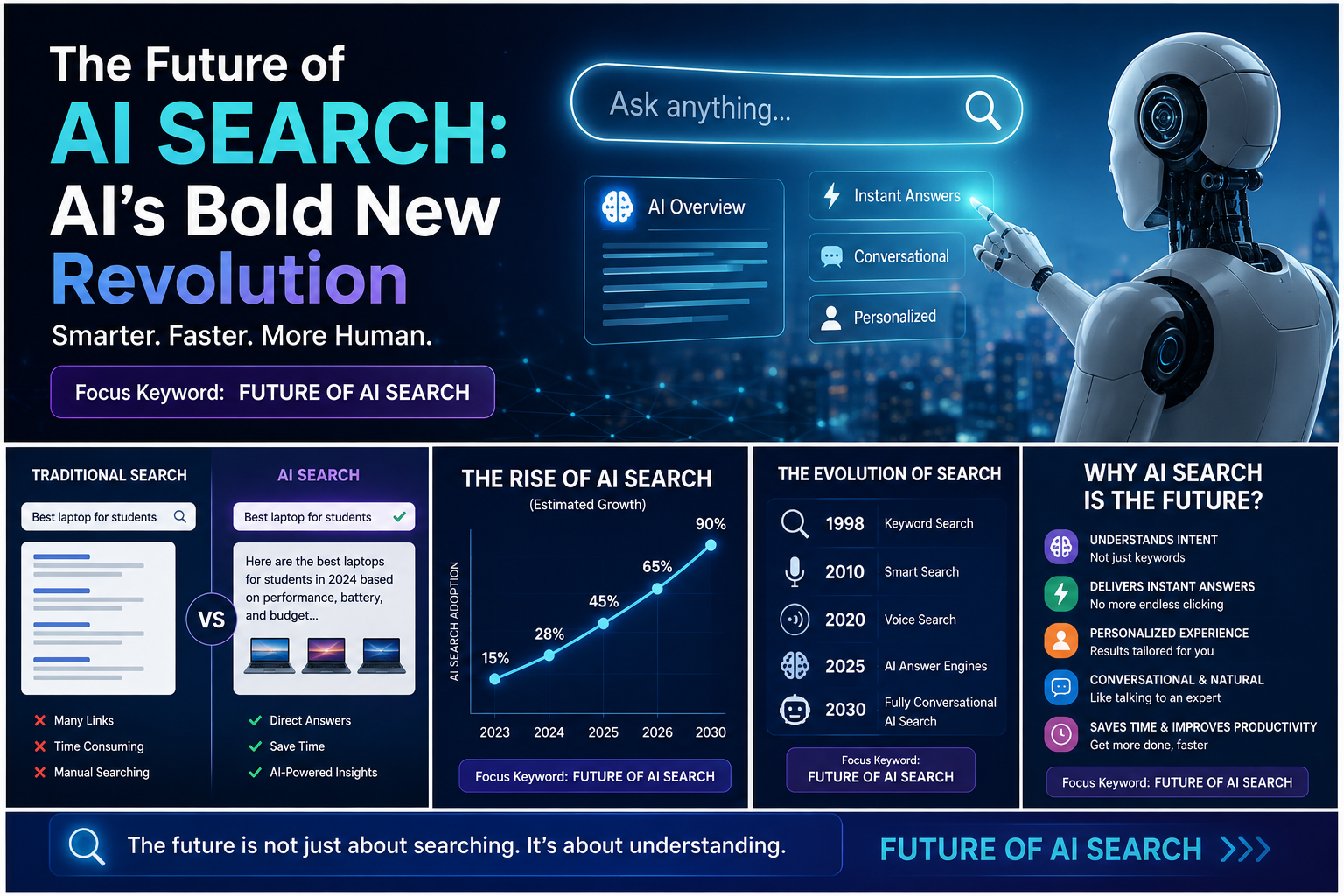
AI SEARCH
Ask Question → AI Understands → Instant Answer
Traditional Search
Search → Open Links → Read Articles → Find Answer
Traditional Search: Traditional Search works like an automated librarian scanning different links and names of websites to the users. It also reads for exact keywords and explores the internet, following links from page to page. More importantly, it copies information from pages and gives you a list of most helpful websites depending on the ranking of the content.In traditional Search, users get:
★ Open multiple websites
★ Read the articles.
★ Compare information.
In AI Overviews, much of the work is done instantly. This is what is changing the behaviour of the users dramatically.
A simple comparison between future of AI Search and Traditional Search:
| Traditional Search | Future of AI Search | |
| INSTANT ANSWER | Automated librarian scanning different links from multiple websites to find a specific answers . | Uses artificial Intelligence to understand, analyze the questions and provide direct answers. |
| COMPLEX QUERIES | Focuses only on keywords -based queries. | Can ask long detailed questions as well as AI also excels with natural, complex languages. |
| ORGANISED INFORMATION | We need to open multiple websites, read and compare the articles to collect information for structured browsing. | It breaks down complex topics, creates lists or categories option for easier browsing. |
| ZERO CLICK RATE | Users must visit other websites to find answers. It has driven a search of zero click rate of 34% | Users find answers without visiting other websites. AI driven search has a higher zero click rate of 93%. |
| MAIN DIFFERENCE | Offers broad access and transparency, but require more user effort. | Highly personalized and efficient and requires less user effort. |
Different Platforms Shaping the Future of AI Search :
The following are the different types of AI Search engines:
ChatGPT: For reliable search and understanding the queries with minimal friction.
Google Gemini: One of the frustrating tools where queries are frequently misinterpreted. Strongly understands Google’s ecosystem.
MS Copilot: Provides best reading experience and well-structured results. It is a solid choice for business users.
Perplexity: An AI sales Engineer, asking questions, offering export options and guiding there search. A fast, interactive research which is efficient and time saving.
Grok: Excellent comparison of tables and large source list.
Deep seek: As the name says, helps in long and detailed research and explanations.
You.Com: An average but reliable tool which provides a wide variety of sources from many websites.
Komo: It is reliable for comparison of tables and transparent top level sources.
Andi: A simple, unique search engine tool which helps in providing options to summaries of source URLs.
Claude AI: Offers high quality and up-to date strong research depth.
Why the Future of AI Search Benefits Users :
AI search engines enhance traditional web searches which have become ideal for users who want detailed, context and rich answers rather than a list of blue links. Here are the following advantages which AI search grant to the users:-
Answer Directly: From AI search, users can receive conversational summaries directly that answers the questions of the users instead of clicking multiple websites.
Understanding accuracy: Users can ask complex, long tail or any conversational queries, AI understands the natural language of the users and receives accurate results than ever before from AI.
Save efforts and time: A user can save time and effort as it does not need to search through multiple websites or pages. The manual labour of scanning, reading and comparing which was done before is no more.
Increased personalization: AI can show results based on context which includes previous searches to provide more relevant data.
Interaction Exploration: Users can ask questions naturally using voice assistants and AI chat bots. The queries can go conversational to dive deeply into the topic. Users now-a-days are searching online and it is becoming more like talking to a smart assistant.
The Future of AI Search and Google Search Evolution:
AI is giving super powers to Google Search. The future of Google search is becoming more intelligent, faster and deeply personalised through AI. In 2026 and beyond, the future of Google search is defined by a transition from traditional keyword based search engine to an AI’s first agentic and conversational assistant, becoming more like a smart digital assistant that understands human conversations, emotions and intentions. The core experience is switching from browsing multiple websites to AI generated direct answers, personalised recommendations, summaries, interactive voice and visual search experience and as a proactive agent that can execute tasks. The statistics showing the future growth of AI search as:
2023 15% AI -Assisted Searches 2024 28% 2025 45% 2026 65% 2030 90% ( Estimated)
The Future of AI for Business Owners, Bloggers and Creators: As AI is evolving, Google search is transforming from a search engine to an intelligent knowledge system that changes the pattern of how people will explore information online. The future of AI will focus more on user experience and this will definitely create a serious challenge for business owners, bloggers and creators to get the reach:
➔ As many users will not click on websites because of AI, the traffic of the website will become low.
➔ AI acts as a proactive assistant and AI generated content is flooding the internet, making it harder to rank higher.
Impact of AI on SEO: The pattern of SEO is changing quickly in 2026. The old traditional methods of SEO are no longer enough now. The changes in SEO, because of AI are:
➔ AI Overviews provide answers directly to the users, leading to Zero click rate in future.
➔ Google wants value based content that truly answers the queries of the users, and will get opportunities to grow here.
➔ Websites which demonstrates high expertise, authority and depth will rank higher as AI uses content to generate summaries.
➔ SEO changed from short focus keywords to long tail keywords.
Example:
Old Keywords: Passive Income
New Keywords: How to earn Passive Income as a student in 2026?.
➔ Only the helpful content will win because the preferences of Google will shift to trustworthy and original articles.
How SEO Must Adapt to the Future of AI Search: Bloggers must optimize the content for:
★ AI Summaries
★ Featured Snippets
★ Conversational Search
★ Long-tail Keywords
How content creators can succeed in the Future of AI Search :
❖ Write original content
❖ Build trust
❖ Focus on Niche
❖ Use long-tail Keywords.
Conclusion: The Future of AI Search: AI Search is transforming the internet from a place of endless links into a world of intelligence. The future of AI Search will be smarter, faster and more conversational than ever before. Instead of fearing AI, smart bloggers and creators should learn on how to work alongside it. 2026, the future of AI Search is no longer just about keywords but it will be about working with intelligence.
EXTERNAL SOURCE:
https://share.google/ucnrHxKwtJeReko11
https://share.google/LN1bqCN2L7vNsUXkA
READ ALSO : INTERNAL LINKS:
https://sumermannwings.com/skills-that-will-be-in-demand-in-next-5-years/
https://sumermannwings.com/rich-mindset-vs-poor-mindset/
<!– wp:post-terms {“term”:”post_tag”,”prefix”:”Future of AI Search\u003cbr\u003eAI Search\u003cbr\u003eAI Search Engines\u003cbr\u003eGoogle AI Search\u003cbr\u003eFuture of Search Engines\u003cbr\u003eAI Search\u003cbr\u003eFuture of AI Search\u003cbr\u003eAI Search Engines\u003cbr\u003eArtificial Intelligence\u003cbr\u003eGoogle AI Search\u003cbr\u003eFuture Technology\u003cbr\u003eAI Revolution\u003cbr\u003eSearch Engine Future\u003cbr\u003eAI-Powered Search\u003cbr\u003eConversational AI\u003cbr\u003e”} /–>
Best Passive Income Ideas for Students in India in 2026 :
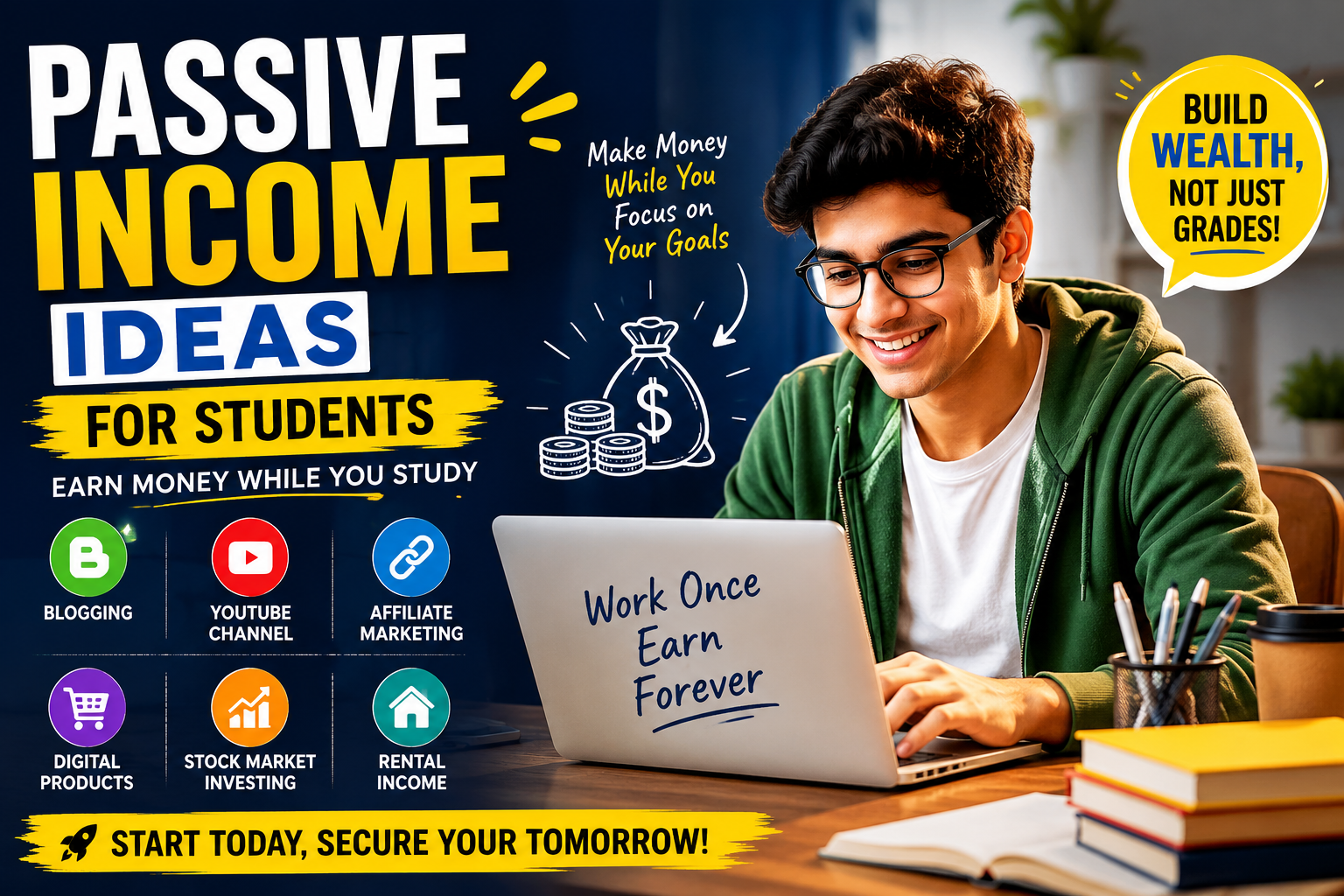
Looking for smart ways to earn without sacrificing your studies? In today’s digital age, passive income ideas for students are becoming more powerful than ever. It has become a smart way to earn money with minimal ongoing efforts. With the right approach, students can build income streams that continue to generate money even while focusing on academics.
Whether it’s through online platforms, digital products or small investments, there are countless opportunities available in 2026. It may require some work in the beginning. Passive income can be generated even while you study, sleep or focus on other goals. In this blog, we will explore the best passive income ideas for students that are easy to start, low-cost and perfect for building long-term financial independence.
What is Passive Income: Passive Income is the money you earn without actively working all the time. It is the money earned with minimal effort, only requiring an initial investment of money, resources and time. Unlike active income (salary), passive income generates revenue over time with little daily maintenance. Common examples include rental properties, dividends and selling digital products.
Smart Passive Income Ideas for Students Without Investment :
● Initial Effort: For passive income, it often requires significant upfront work or capital initially, but requires minimal effort later.
● Investments: Dividends from stocks, bonds, interest from high yield saving accounts and REIT’s.
● Rental properties/assets: Renting out properties like office spaces, home, parking space, vehicles or equipment.
● Digital content: Selling online courses, creating e-books, ghost writing, marketing or promoting digital products that generate loyalty over time.
● Business ownership: Being a silent partner or owner of a business that is operated by others.
What do we gain from passive income ideas:
● Financial independence: Enables earning without active daily labour, allowing for early retirement or focus on other pursuits.
● Diversification: Helps build multiple income streams to control inflation and unemployment.
Passive income is often taxed, and in some jurisdictions, it may be subject to different regulations. Here are the following differences through which passive income can be generated. They are
➢ Investment Based passive income.
➢ Digital/content based passive income.
➢ Asset based passive income.
Investment based passive income:The following are the different ways through which passive income ideas for students can be generated:
REIT (Real Estate Investment Trust): REIT’s are commercial property based portfolios. Investing in REITs without owning physical properties.
BONDS/Sovereign Gold Bonds: Lending money to the government and investing in Bonds in Government offices or in Gold Bonds for regular interest payments.
Dividend Stocks: Purchasing shares in those companies which yields high – dividend profits to shareholders.
Digital/ content based passive income :
Blogging / YouTube channel: This is the most acceptable and vulnerable platform for all those students who are interested in earning passive income. Producing videos or writing articles or blogs that generate income through monetization or AdSense and affiliating like overtime.
Online courses: Creating educational content to sell on platforms, to generate passive income.
Print on demand: Designing apparel or mugs which involves handling of painting and shipping, can be sold through digital platforms.
Asset based passive income:
Renting assets: Renting assets like homes, offices, warehouses, vehicles also gives you passive income.
Renting property: Leasing residential or commercial real estate for monthly cash flow.
Best Online Passive Income Ideas for Students :
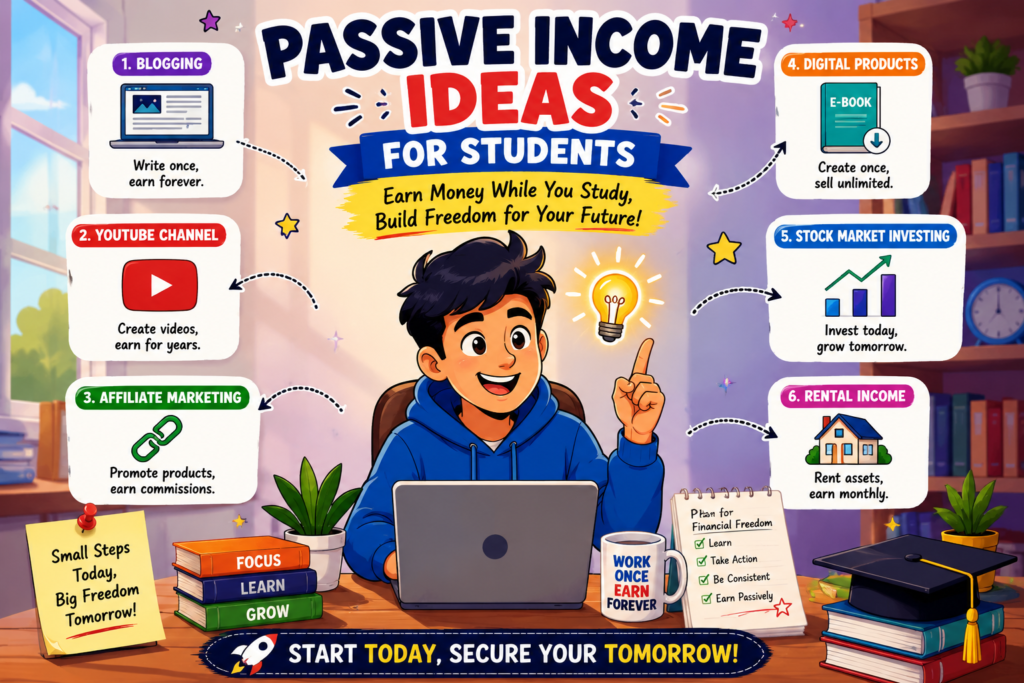
The following are the different ways in which we can make passive income (The best passive income ideas for students in 2026):
Blogging: Starting a blog is one of the most powerful income methods. Blogging is the act of regularly writing, updating and publishing articles on a website, typically focusing on a specific topic or niche. In 2026, blogging remains a profitable, long term venture. Even though it is rarely “get – rich – quickly”, it offers significant passive income once you gain traffic and trust from theaudience. Unlike traditional jobs, you don’t trade houses for money continuously. Instead you build a system once and earn from it repeatedly.
How to make passive income through Blogging: Passive income in blogging means generating revenue from content you created. Here are the following ways to generate revenue:
Affiliate marketing: You recommend products or services using unique tracking links. When readers purchase through your link, you earn commission.
Display Ads: Placing Ads on your site via different networks, you get paid per impression or click.
Sponsored posts: Getting paid directly by brands to review or feature their product.
Steps to start a profitable blog in 2026:
1. Choose a profitable niche.
2. Select a platform and hosting.
3.Focus on quality SEO content.
4. Build an email list.
5. Be consistent and patient.
Insights: Focus on SEO to get free traffic from Google.
Example:
➔ Gaurav Tiwari, an Indian blogger.
Main topics – technology, education, business and blogging. The blog even offers various free tools, guides and study notes for readers of different niches.
➔ Peter Rojas – Engadget
Main topics – technology, gadgets, consumer Electronics. This is a technological blog providing reviews of gadgets and consumer Electronics as well as latest news in the tech world.
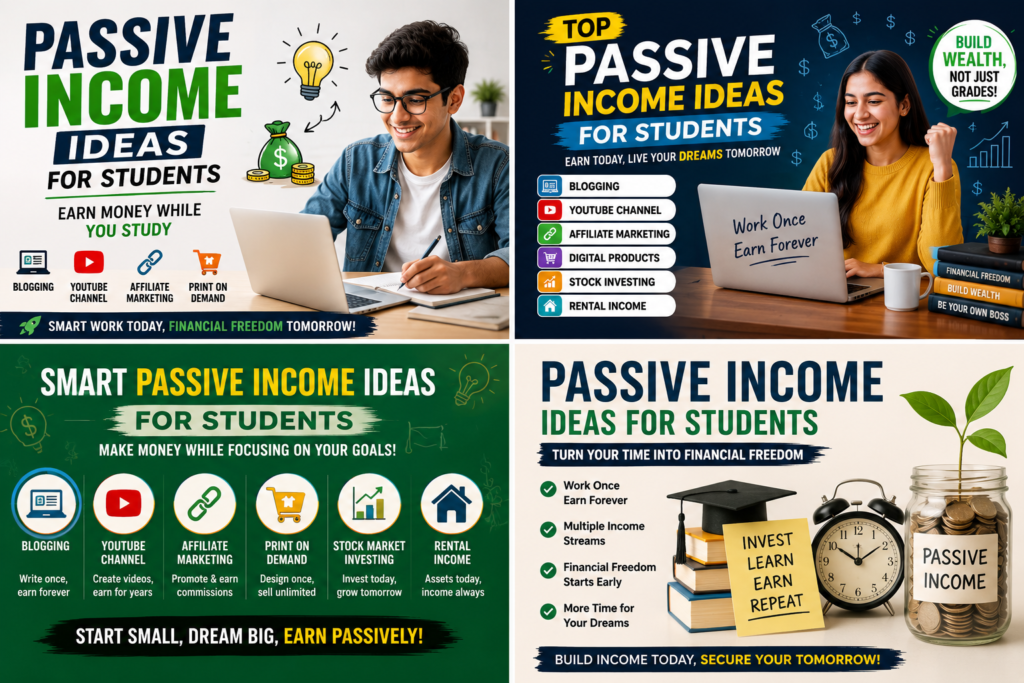
You Tube Channel: A channel on YouTube platform is a personalized, public presence that acts as a personal hub or brand page, where creators can upload or share video content including vlogs, tutorials, entertainment or educational material and get engaged with viewers throughcomments. Creating videos can generate passive income over time. Once your videos gain views, they continue to earn money.
Features of You Tube Channel:
Content Ideas: Video content, vlog, tutorials, tech reviews, study material.
Functionality: Channel allows you to upload, manage and organise the videos.
Customisation: Creators can customize their channel name, profile picture and layout too.
Interaction: Viewers can subscribe to channels to receive updates and creators can interact with their audience through comments.
Income Source: Display Ads, Sponsorships, Affiliate links.
Steps to Create a YouTube channel in 2026:
❖ Sign In : Navigate to YouTube and sign in with a Google account.
❖ Create Channel: Click your profile picture in the top-right corner and select “CREATE A CHANNEL”.
❖ Setup the details: Choose a name for your channel (@username) and upload an image to represent your channel.
❖ Confirm It: Click “CREATE CHANNEL” to activate it.
Examples of YouTube channel:
1. Mr. Beast ( ENTERTAINMENT)
2. Sandeep Maheshwari ( motivation)
AFFILIATE MARKETING: Affiliate Marketing is a performance based advertising model where individuals or businesses earn a commission for prompting another company’s service or products. It allows you to promote products and earn commission for each sale made through the link. It involves merchants, the affiliate and the consumer.
Where to share Affiliate Marketing: In Blogs, Instagram, You Tube Channel.
Best for : Students who don’t wait to create their own products.
How it works:
➢ The affiliate joins a merchant’s program.
➢ The affiliate receives a unique link or code.
➢ The consumer clicks the link to make a purchase.
➢ The merchant trades the sale via the link and pays the commission.
Common pay- out models:
★ Pay-per-sale : Commission for every sale generated.
★ Pay-per-click : Commission for driving traffic.
★ Pay-per-lead : Commission for actions like sign-ups or for submission.
Selling Digital Products: Selling digital products is the process of creating, marketing and selling intangible electronic goods such as Ebooks, templates, courses or software, that are delivered instantly online to customers. It is a high margin automated business model where items are created once and sold multiple times without inventory or shipping. The following are the different platforms where digital products are sold and are popular among beginners- Etsy,Gumroad, Shopify.
Popular Types of Digital Products includes:
● Educational Materials – E books, online courses.
● Template – Canva template, website theme, Stock photos.
● Software and Apps – SaaS products, mobile apps, plugins.
● Digital Tools – Planner, printable trackers.
● Audio/video – Presets, music and digital art.
Stock Market Investing: Investing in stocks or mutual funds can help you earn passive income by involving in purchasing shares of publicly traded companies, by buying partial ownership with the goal of growing wealth over the long term. Investors earn profit through share price application or dividends. There are three ways to invest in stock market:-
★ Direct stock buying.
★ Stock market funds.
★ Exchange Traded Funds (ETF).
Always Remember (Important) – Start with a small investment and very important is to learn or study the market before investing.
Insight – Focus on long term wealth creation rather than quick profits.
Print On Demand Business: Print on Demand (POD) is a low risk e-commerce business model where custom designed products like T-shirts, mugs, phone cases and books are printed and shipped only after a customer places an order. In short, you can design them and sell online without holding inventory because sellers partner with third party supplies, who handle inventory, printing and shipping.
How the POD model woks:
➔ Create Design: Upload your creative and unique design.
➔ List the products: List your items on online stores.
➔ Customer order: Customer purchases an item, the order is set to the supplier.
➔ Production and shipping: The company prints the design and ships directly to the customer under your brand.
➔ Profit: Profit is the difference between selling profit and production cost, which is yours.
Few other passive income ideas for students:
Mobile Apps and Micro Tasks:
Mobile Apps: Mobile Apps are software applications designed to run on smart phones or tablets, offering specific functionalities ranging from social media, entertainment, shopping to banking. They are downloaded via app stores and provide a tailored user experience.
Micro Tasks : Micro Tasks are tiny, simple digital tasks such as data entry, image tagging or surveys. They are the small components of a larger projects, outsourced to a large group of people via online platforms.
Similarities between Mobile Apps and Micro Tasks:
1. Many micro tasks are completed on mobile phones through apps, enabling users to earn money in their spare.
2. Some Mobile Apps requires users to do real world micro tasks such as taking photos of shops display or evaluating location.
Examples : Cash back apps, survey apps.
Selling Photos Online: If you enjoy photography, you can upload your images to stock photo websites.
Platforms: Shutterstock, Adobe Stock
Earning method: Get paid when someone downloads your photo.
Create an Online Course: If you have knowledge in any subject or skill, you can create a course and sell it online.
Platforms: Udemy, Skillshare
Benefit: Earn repeatedly from one-time effort.
Dropshipping: Dropshipping allows you to sell products online without managing inventory.
How it works: You list products → customer orders → supplier ships directly
Focus: Marketing and customer service.
Final Advice on generating passive income ideas for students:
The future of earning is changing, and students who start early will have a major advantage. These passive income ideas for students can help you build financial independence, improve your skills, and create long-term opportunities while continuing your studies. The key to success is consistency, patience, and a willingness to learn. Start with one idea, stay focused, and keep improving step by step. With dedication and smart effort, students in India can turn small beginnings into a stable source of passive income in 2026 and beyond.
EXTERNAL REFERENCE:
https://www.bankrate.com/investing/passive-income-ideas/#passive-income-real-estate
https://share.google/N5kKhYHhQ8ZiYknUs
INTERNAL REFERENCES:
https://sumermannwings.com/how-to-save-money-as-a-student-with-low-income/
https://sumermannwings.com/rich-mindset-vs-poor-mindset/
https://sumermannwings.com/emotional-spending/
<!– wp:post-terms {“term”:”post_tag”,”prefix”:”passive income ideas for students\u003cbr\u003epassive income for students\u003cbr\u003estudent side hustle ideas\u003cbr\u003eonline earning for students\u003cbr\u003eearn money while studying\u003cbr\u003epassive income ideas 2026\u003cbr\u003emake money online for students\u003cbr\u003estudent income ideas\u003cbr\u003eonline jobs for students\u003cbr\u003eblogging for students\u003cbr\u003eaffiliate marketing for students\u003cbr\u003eYouTube channel ideas for students\u003cbr\u003edigital products business\u003cbr\u003eprint on demand business\u003cbr\u003estock market investing for beginners\u003cbr\u003efinancial freedom for students\u003cbr\u003epassive income ideas for students\u003cbr\u003eearn money while studying\u003cbr\u003eonline earning for students\u003cbr\u003estudent side hustle ideas\u003cbr\u003epassive income for students in 2026″} /–>
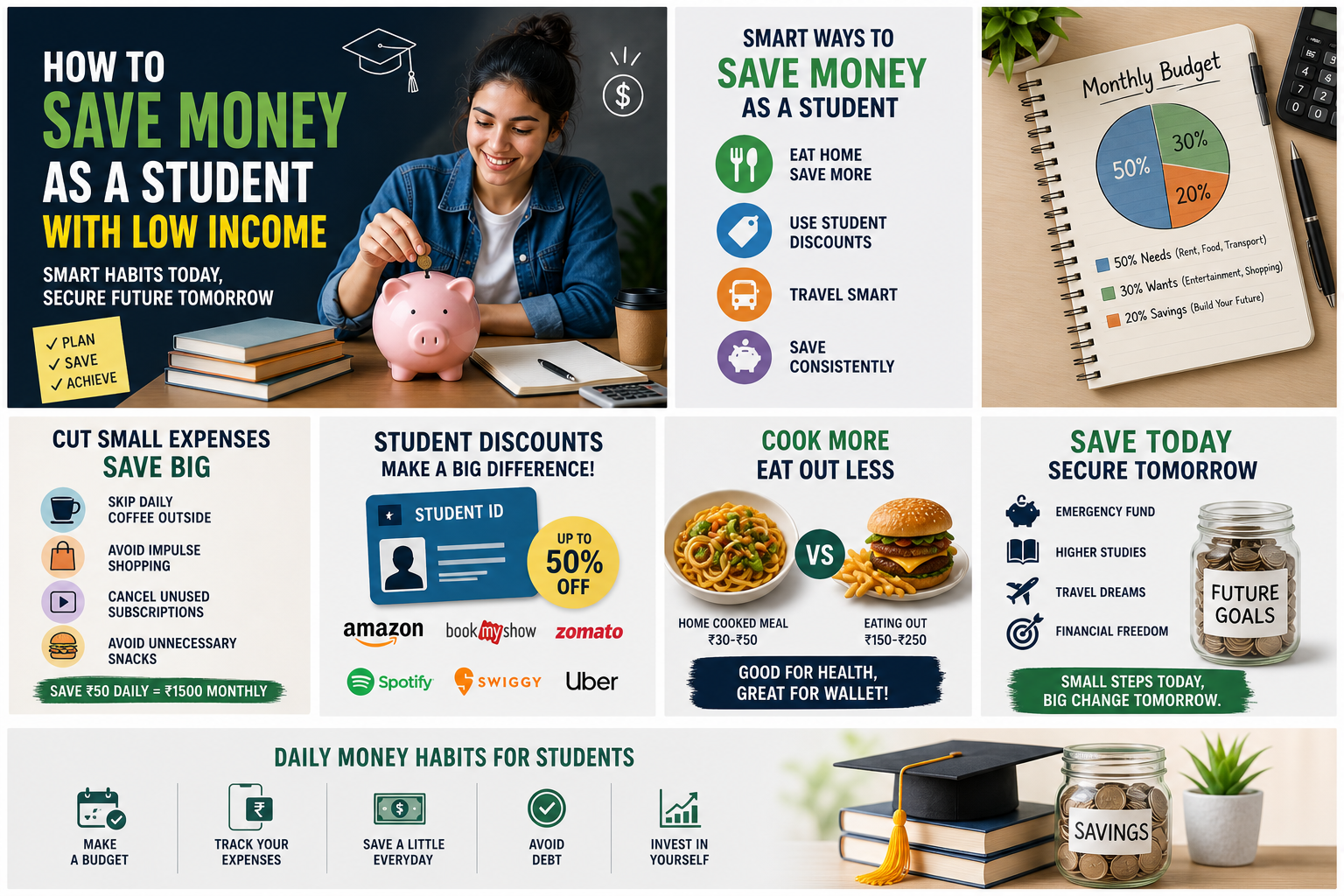
How to Save Money as a Student with Low Income: A Complete Guide :
If you are wondering how to save money as a student with low income, you are not alone. Many students struggle to balance expenses and savings, thinking it’s possible only when income increases. Between tuition fees, travel, food and other daily expenses it seems like there is nothing left to save. But the truth is saving money is not about earning more, it’s about managing what you have.
Small daily decisions can make a big difference and most importantly, you don’t need high income to start saving, you just need the right strategy. With smart habits and the right strategies, even students with low income can start building savings and gaining financial control. So, in this blog, you will see simple and practical ways to save money, even on a tight budget.
Why Learning How to Save Money as a Student with Low Income Matters:
Saving money as a student can be incredibly tough when there can be so many things that demand your attention. From purchasing study materials to security accommodation, eating well and entertaining yourself and friends, working on a manageable budget can feel nearly impossible. It requires creating a strict budget, cooking at home and leveraging student discounts.
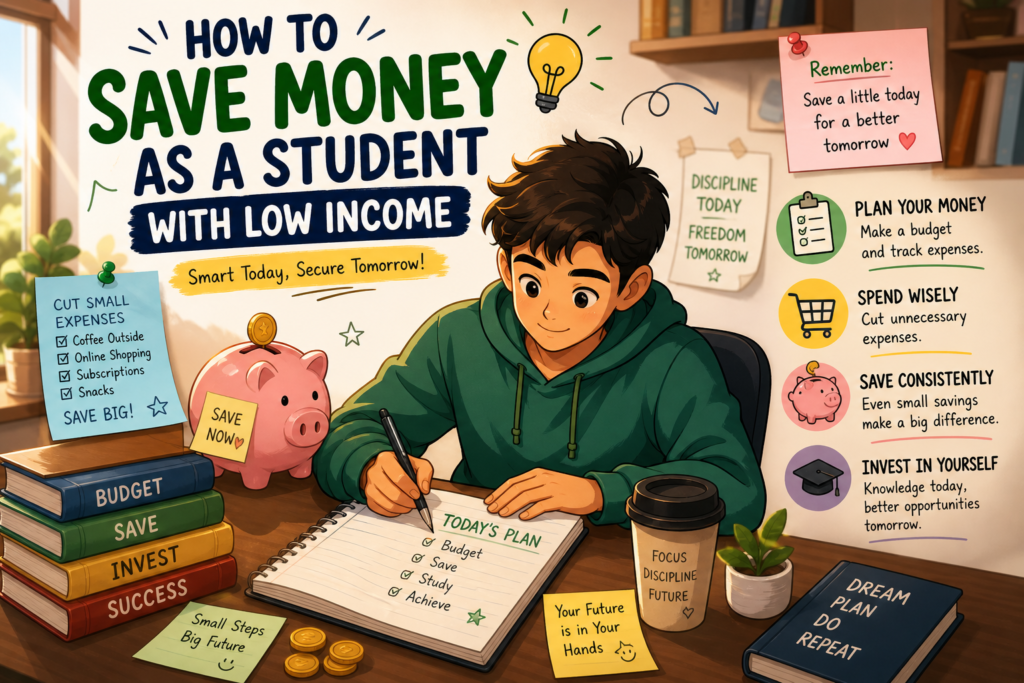
What is Soft saving: Soft saving is a financial trend, popular among Genz and millennials, that prioritises present day enjoyment, mental well-being and experiences over aggressive savings for a far off retirement. Soft saving is replacing the acronym FIRE (financial independence, retire early). Unlike FIRE, which emphasizes on extreme savings in the interest of early retirement, soft savers aim to feel financially and emotionally satisfied in the present, saving only what’s left after their current needs are met. It rejects “hustle culture” in favour of a “soft lie”, where income is used for comfort and quality of life now, rather than long term security.
Examples of Soft Saving:
❖ Spending money on travel, concert tickets or hobbies.
❖ Setting aside a smaller income for comfort life and spending the rest of the income for leisure.
❖ Spending on mental health like therapies, educational and personal development classes like yoga, workshops to boost current well being.
❖ Focusing on short term goals like “I need a laptop”, rather than long term overwhelming goals like “saving for a 30 year retirement”.
Why is Genz not saving money? Genz is saving less due to high inflation, soaring costs of living (rent/ student debt) and a psychological shift which is known as “Financial Nihilism”, where hopelessness regarding traditional wealth building fuels a “soft saving” approach that priorities small scale experiences over long term financial security. Only 20% of Genzers are saving for retirement. Here are the following breakdowns as to why Genz’s are not having saving habits.
Inflation and Survival Spending: Roughly 80% of Gen Z and millennials are engaged in survival spending and spending the majority of their income on immediate necessities.
Soft Saving and Experience Priority: Instead of focusing on long term savings plans or aggressive savings for early retirement, Gen z and millennials are focusing on “Soft Saving” mode, setting aside less money to enjoy present comfort, mental health and travel over longterm goals.
Financial Nihilism and Hopelessness: Many young people feel traditional financial advice is outdated. And so, this leads to a feeling that saving is pointless.
Digital Tools and Instant Gratification: The rise of buy-now-pay-later (BPNL) services, instant credit card and digital convenience encourages immediate consumption over waiting to save.
High Cost of Living and Debt: They face high fixed costs, which includes student debts, rents etc..
Smart Strategies on How to Save Money as a Student with Low Income:
The following are the different ways and ideas through which students can save money with low income:
Budgeting Tips: How to Save Money as a Student with Low Income:
Understand where your money goes: Before starting to save, create a budget and track your income and expenses to understand your spending. Even using apps or a notebook, anyone can track it and maintain the record. Firstly, write down:
★ Daily Spending
★ Monthly bill
★ Unnecessary purchases/ expenses.
This helps you to identify where you are wasting money.
Follow the 50-30-20 Rule (Simple Version): This rule states that even if the income is low, we can divide the money in a 50-30-20 rule way.
➢ 50% of income on needs relating to food, travel, rent, groceries, gas, medical and any other daily needed expenses.
➢ 30% of income goes to wants, which includes your entertainment, shopping etc..
➢ 20% of income to savings. If you feel 20% is hard to save, then you can even start up with 5% -10% of savings, which is also great in the beginning.
Cut down Small or Unnecessary Expenses: There are daily expenses which may look small but are actually draining your money. Habits like:
➔ Online impulsive shopping
➔ Buying snacks/ tea daily
➔ Buying subscriptions out of which you don’t use many.
In this way, the money is drained and savings go null. So, in such cases, you can avoid the above expenses and try to save at least 50 rupees daily. So, at the end of the month, it becomes 1500 rupees.
Use Students Discounts and Offers: Always look for automated savings that gets transferred automatically to your savings account. No worries, even if the amount is small. Go for:
★ Students discount
★ Budget deals
★ Cash back Offers
24-HOUR rule: This is one of the important ways in saving income. Avoid any expenses or shopping with this rule. Let’s see how it works: Wait for 24 hours before purchasing any non-essential. In these 24 hours, you can wait and think whether the non-essential is required or not.
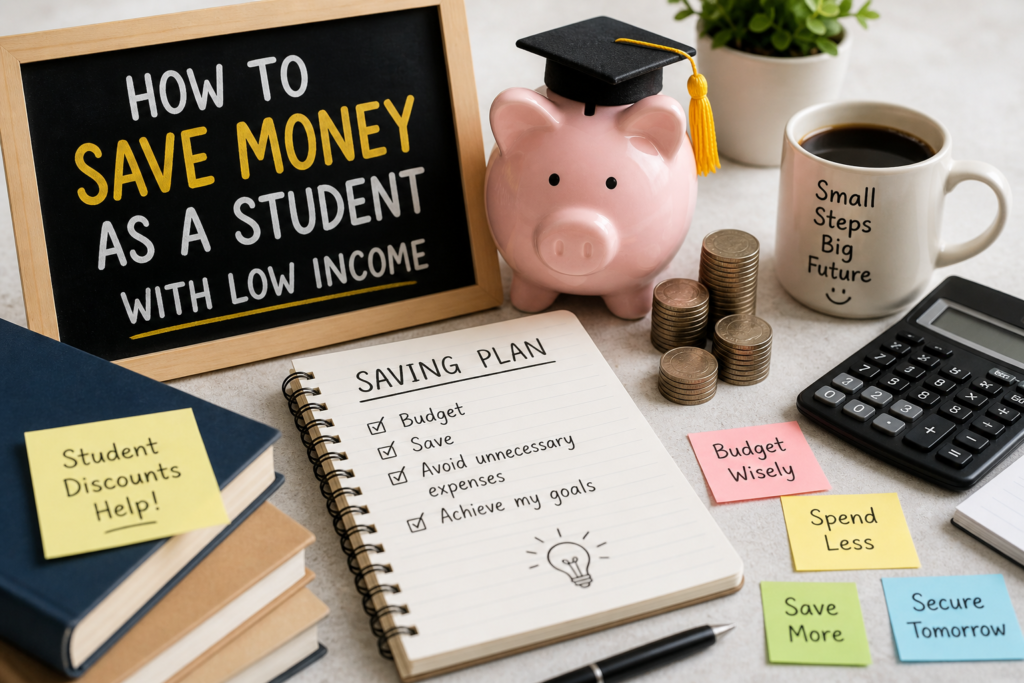
Daily Habits to Master How to Save Money as a Student with Low Income:
Cook More, Eat Out Less: Eating outside regularly is expensive. Make your own coffee and meals to save on daily takeaways and dining out. You can save money with low income also by doing this:
★ Share groceries with friends
★ Avoid frequent food delivery
★ Cook simple meals.
This process can save thousands per month.
Buy Used or Share Resources: Instead of buying new, you can opt for:
➢ Buy second hand books
➢ Share notes with friends
➢ Use free online platforms
➢ Use library resources
➢ Opt for digital versions.
Smart students reduce costs, not quality.
Set a Saving Goal: Saving without goals doesn’t work. If you set a goal, your savings will get a definition and it will all be worth the goal. So, set the goals like:
➔ Keep 5000 rupees as an emergency fund
➔ Buying a laptop
➔ Travel fund
Setting goals can give your savings a purpose and also motivation.
Reduce Energy Bills: Turn off lights and unplug electronics when not in use. Keeping small- small things into consideration will help a lot in achieving the saving goal.
Lifestyle Changes to Improve How to Save Money as a Student with Low Income
Public Transport / Carpool: Instead of going by bike or cabs, opt for public transport like metro or buses.
Free Entertainment: Look for free campus events, museum parks and hiking instead of expensive movies or concerts.
Start a Small Side Income: Even a small side income can help you save more. You can work on works like:
➔ Freelancing
➔ Tutoring
➔ Content Writing
➔ Setting digital products
Remember one thing, any extra income will make a big difference.
Financial Discipline: Key to How to Save Money as a Student with Low Income :
Avoid Debt and Unnecessary Loans: This is a very important aspect of maintaining finance and regulating savings from it. Many students fall into Debt early because:
❖ They want to create a status among their circle and maintain a high standard of living which pays high cost.
❖ They use credit cards for their lifestyle and later take loans to clear their credits.
❖ Spend from the income what you have and not by taking loans.
Always remember, debt will destroy your financial freedom.
Build a Saving Habit: This is another very important concept in saving income – build a Saving Habit. Saving is not about income, but it is primarily about making it a habit. So, you can start with:
★ Saving 10 rupees per day
★ Saving 100 rupees per week.
Following this habit will bring consistency and consistency matters more than amount.
REFERENCES:
https://share.google/IoKfegsq67ssopmn0
https://share.google/EKcFTMngYcImrt5OH
REFERENCES:
https://sumermannwings.com/emotional-spending/
https://sumermannwings.com/rich-mindset-vs-poor-mindset/
https://sumermannwings.com/how-to-control-emotional-triggers/
Final Thoughts on How to Save Money as a Student with Low Income: Learning how to save money as a student with low income is not about making big sacrifices, it’s about making smart choices every day. Even small steps like tracking your expenses, cutting unnecessary spending, and saving a little regularly can create a big impact.Remember, you don’t need to wait until you earn more to start saving.
Start with what you have, stay consistent, and build strong financial habits early in life. As we discussed in the blog, “How to Save Money as a Student with Low Income”, the key is discipline, not income. The sooner you take control of your money, the stronger your financial future will be. Start today,because every small saving brings you one step closer to financial freedom.
<!– wp:post-terms {“term”:”post_tag”,”prefix”:”how to save money as a student with low income\u003cbr\u003esave money as a student\u003cbr\u003estudent budgeting tips\u003cbr\u003elow income saving tips\u003cbr\u003estudent money management\u003cbr\u003e”,”suffix”:”student budget planning tips\u003cbr\u003emoney saving ideas for college students\u003cbr\u003esimple saving tips for students on a budget\u003cbr\u003esaving habits for students\u003cbr\u003ehow to live on a student budget\u003cbr\u003egen z money habits\u003cbr\u003esoft saving trend\u003cbr\u003efinancial freedom tips\u003cbr\u003eside income for students\u003cbr\u003e”} /–>


