
Nurturing Health
E in food products expose the truth about additives

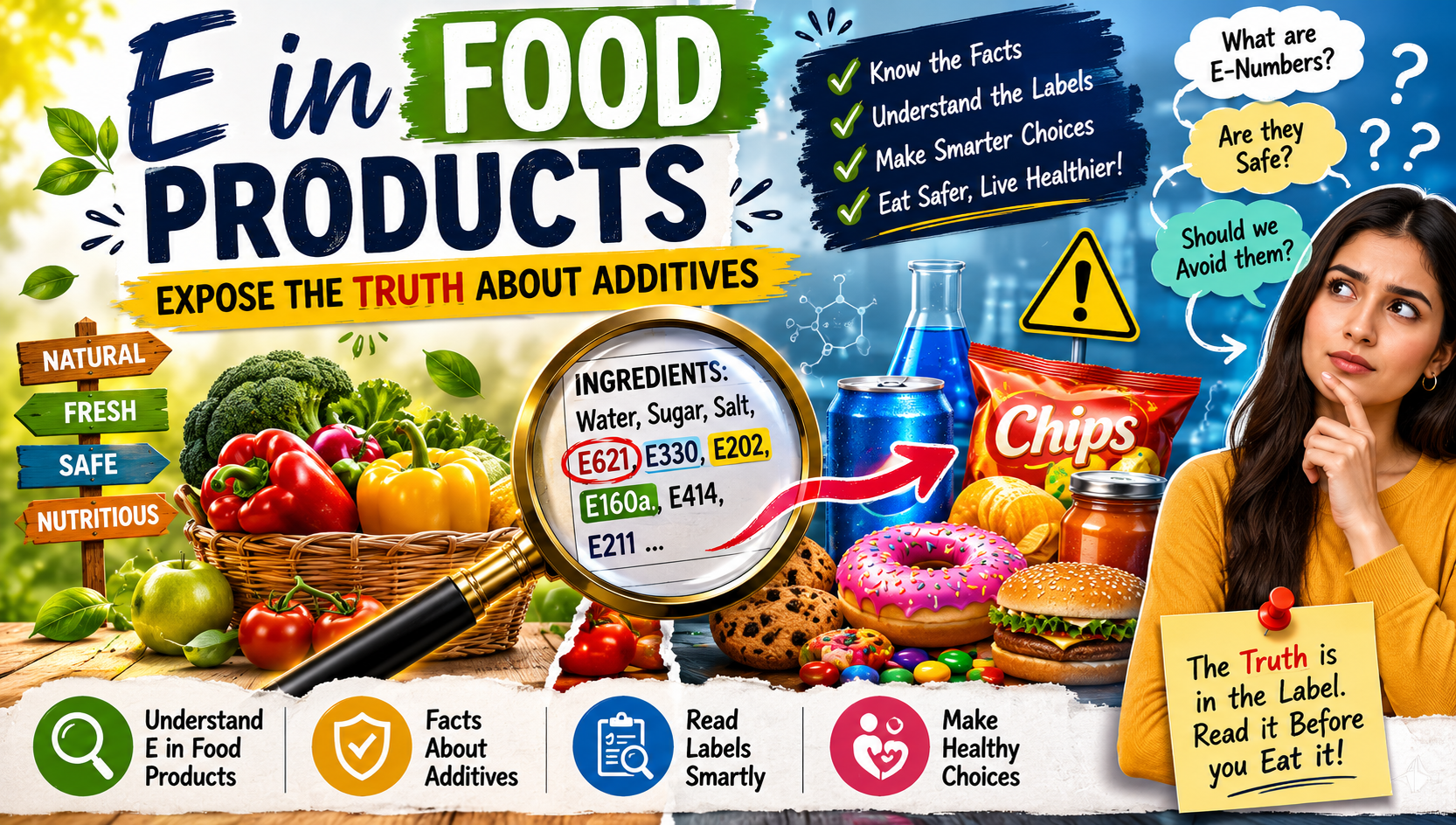
What Is E in Food Products? (Introduction) :
Many of us are purely vegetarian and eat only vegetarian food. Now-a-days, many non-vegetarian as well as vegetarian people are shifting to veganism. But wait, let me tell you a little more interesting that will shock you, the inside news of the vegetarian food sold in the market. Have you ever checked the ingredients list on a packed food and noticed codes like E300, E330 or E621 and wondered what they mean.
The term E in food products refers to E- numbers, which are codes used to identify approved food additives. These additives help improve flavor, preserve freshness, maintain texture and enhance appearance. Many people assume E- numbers are harmful, but not all of them are artificial and unsafe. Understanding E in food products can help consumers make informed choices and better understand what goes into the food they eat.
Understanding the Meaning of E in Food Products:
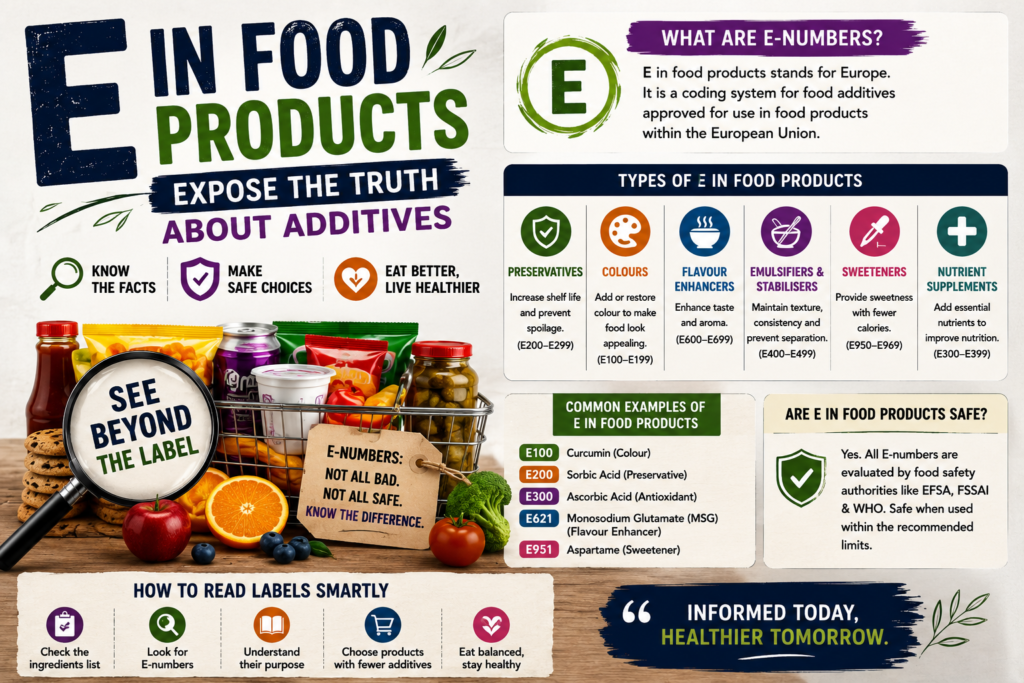
What are food E-numbers?: The “E” in E numbers on a food label stands for Europe. Food E-numbers are a set of codes for substances used as food additives instead of printing long scientific names on labels. These numbers are commonly found on food labels, their safety assessment and approval are the responsibility of Regulatory Authorities.
A single unified list for food additives was first agreed in 1962 with food coloring. Later in 1964, the preservatives were added and in 1970 antioxidants were added in. Emulsifiers, stabilisers, thickeners and gelling agents were added in 1974. These E numbers can make the ingredients list easier to read and more consistent across products. These code numbers can be created for any substances that fit the following three categories:
❖ Substances that are not normally consumed as food itself.
❖ Substances that may or may not have any nutritional value.
❖ Substances that are purposefully added to the food during manufacturing, processing, packaging, preparing, transporting to store the food to achieve the end product you find in the store.
Examples of E numbers in vegetarian ‘s food list:
1. An E number E631, a flavor enhancer, is found commonly in variety of snacks, lays, noodles etc. But when you Google it, a preservative, whose another name is DISODIUM INOSINATE, is generally produced from meat, including pig and fish.
2. A “Cochineal Insect”, which looks like a ladybug is being crushed up and used in lot of products as Crimson lake or carmine lake, natural red 4, C.I.75470 or E120, is a pigment of bright red color derived from the dried, crushed bodies of female Cochineal Insect. Confectionery, dairy and beverages, meat and savouries and even cosmetics industry too use this additive.
The Hidden Truth About E in Food Products and Food Additives :
Food additives are synthetic or natural substances added to food during the making, processing or packaging of the food to improve its safety, preserve the freshness and maintain the taste, texture, quality and appearance. Food additives can be:
➔ Natural
➔ Nature derived
➔ Artificially processed.
Not all E numbers are artificial chemicals. Some are familiar ingredients such as vitamins and fruit based compounds. Food additives are meant to guarantee food safety and keep food quality high.
Example: For example, when you buy a chocolate, you probably have an expectation with regard to the taste, quality, texture, cost etc. of the chocolate. All these expectations are fully assembled in the product with the additives. So, even though food additives are not the main ingredient, they play an important role in meeting consumer expectations.
Types of Food Products You Should Know :
1. Preservatives – prevent the growth of microorganisms and delay oxidation, which extends shelf life.
2. Sweeteners: Add sweetness without calories of traditional sugar.
3. Colorants: Add or restore the colour lost during processing.
4. Flavor Enhancers: Amplify the existing taste or aroma of food.
5. Emulsifiers & Stabilisers: Help in mixing the ingredients that typically separates oil and water.
6. Nutrient Supplements: Add vitamins and minerals to food to improve nutritional value.
EXTERNAL REFERENCES :
https://share.google/lubLpsffM9BdnmgmD
https://share.google/2YwcZoTIkRjmUXJ8O
INTERNAL REFERENCES :
https://sumermannwings.com/meaning-of-food/
https://sumermannwings.com/abhakshya/
How E in Food Products Works in Everyday Foods :
Food additives such as emulsifiers, stabilisers, antioxidants, thickening agents etc. are added to give certain physical quality to food including the texture. Flavor enhancers, sweeteners, colorants change the flavour of foods.
Why Is E in Food Products Added to Food? :
The following are the various reasons why food manufacturers add additives:
Increase Shelf Life: By adding the preservatives to any food item, it helps in preventing spoilage and also reduces food waste.
Maintain flavor: By adding some additives, it helps in maintaining the colour and preserving the taste of the food.
Improve Appearance: By adding the colour additive, it improves the appearance of the product.
Enhance Texture: Emulsifiers and stabilizers keep the ingredient consistent and mixed.
Common Examples of E in Food Products Found on Labels :
➢ E100-E199 – Colours – E100 – Curcumin, E160a – Carotenes.
➢ E200-E299 – Preservatives – E202 – Potassium sorbate, E250 – Sodium nitrite.
➢ E300-E300 – Antioxidants and Acidity regulators – E300 – Ascorbic acid/ Vitamin C, E322 – Lecithins.
➢ E400-E499 – Emulsifiers, Stabilizers, thickeners – E415 – Xanthan gum, E440 – Pectin.
➢ E500-E599 – Acidity regulators and anti – caking agents – E500 – Sodium Carbonate.
➢ E600-E699 – Flavour Enhancer – E621 – monosodium glutamate.
➢ E900-E999 – Sweeteners and Glazing Agents – E951 – Aspartame, E967 – Xylitol.
➢ E1000-E1599 – Additional additives – Miscellaneous additives like waxes, enzymes and packaging gases.
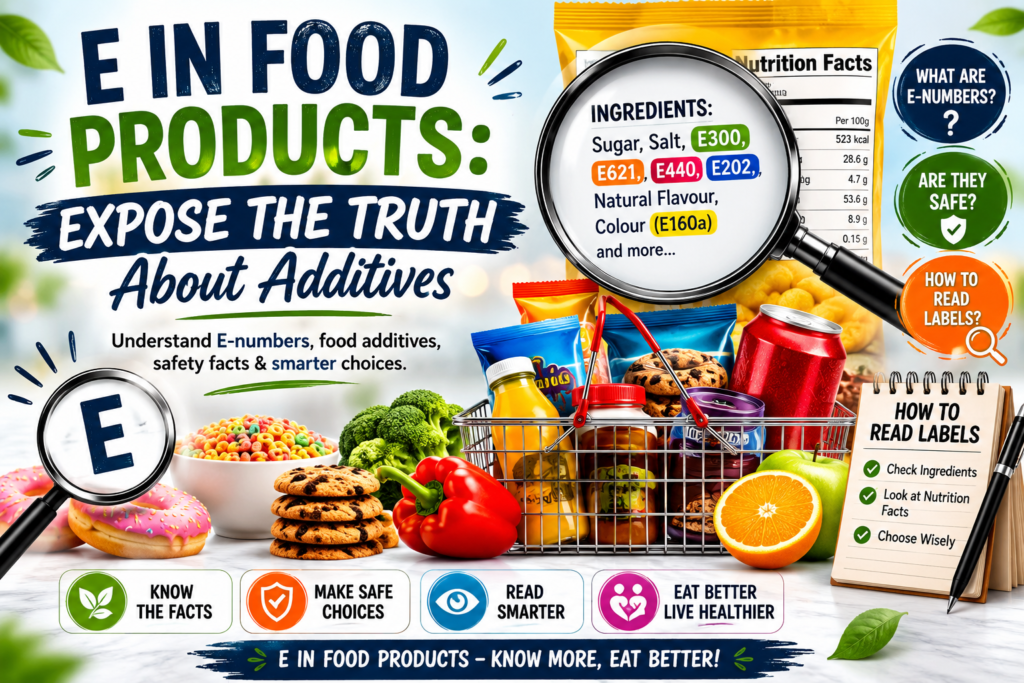
Is E in Food Products Safe? Facts You Need to Know :
There is a common myth that E-numbers are harmful. In reality, E-numbers are generally considered safe for consumption. An E-number simply means the additive has been reviewed and approved for permitted use under food regulations. These E-numbers have passed strict safety evaluations and are authorised for use. Many approved additives are ingredients people already consume regularly like:
➔ E100 : Curcumin ( turmeric extract)
➔ E160d : Lycopene ( found in tomatoes)
➔ E300 : Vitamin C (Ascorbic acid)
➔ E440 : Pectin ( fruit based thickener)
How to Read Labels and Identify E in Food Products :
Instead of avoiding products simply because they contain E-numbers, prepare food labels better, start by serving size and servings per container, as all nutritional values apply only to one serving. In understanding the concept of reading the labels in better way, the following guidelines can be followed:
★ Read the complete ingredient list
★ Look at the overall nutritional profile.
★ Limit excessive ultra processed foods.
★ Focus on balance and moderation.
what you need to prioritise while reading the label:
Higher : Vitamin D, Calcium, Iron, Potassium, Dietary fiber.
Lower : Saturated fat, Sodium, added sugar.
The Final Truth About E in Food Products (Conclusion) :
Finally, E in food products simply refers to approved food additives that are usedto improve the quality and shelf life of a product. Maybe E-numbers are confusing, but that doesn’t mean they are unhealthy and unsafe. By understanding the ingredient label, the consumers will make more informed choices. Knowing the meaning of E in food products, helps create better awareness about what we eat everyday.


The cough that bothers you all day is dangerous enough. however after they keep you up all night, you’ll feel atrocious. however are you able to calm a cough, therefore, you’ll get the sleep you need?
You’re lucky. There are several nighttime cough treatments that may facilitate. Most of the time, home remedies or over-the-counter (OTC) treatments will work wonders. however, if that does not facilitate, your doctor could dictate a stronger cough drug that features one thing to create you asleep.
How to calm that cough
Start with easy solutions to visualize if they stop hacking:
Use a humidifier to moisten the air, or respire steam from a hot shower or kettle before bed.
Prop your head a small amount with an additional pillow.
Try saline or H2O nasal spray.
Swallow a teaspoon of honey. (Note: this is often not for babies beneath one year recent.)
Drink hot tea or soup. Suck on application lozenges or honey before planning to bed.
If you would like stronger relief, chemist’s shelves are packed with over-the-counter cough or cold remedies that you simply will try and stop your cough. This product could have a mix of various sorts of drugs in one capsule or pill:
A cough appetite suppressant. It works by interfering with your cough reflex. Dextromethorphan is the commonest. A medication like adrenergic or alkaloid to clear a stuffy nose or sinuses
A medicament, like brompheniramine, chlorpheniramine, antihistamine, or doxylamine, to prevent unconditioned reflex and a liquid nose. A medicine that thins mucous secretion, referred to as associate medicine
But be careful: These cough treatments create some individuals feel drowsy, however, they create others feel buoyant and stay up. and a few of them are not safe to require if you have got health issues, like high-pressure levels. therefore refer to your doctor before shopping for one.
Nasal sprays with or while not steroids may also facilitate relieving a cough.
What causes a cough?
When you have a chilly, sinus infection, or the flu, mucous secretion will drip from your stuffy nose or sinuses into your throat after you lie to sleep. this is often why you’ll cough additional at midnight. you’ll feel the drip tickling the rear of your throat and need to cough to clear the blockage.
But alternative conditions may also cause a cough that keeps you awake:
Asthma. The air passages within the lungs slim and shut, and an excessive amount of mucous secretion will build up. individuals with asthma attacks may also have a dry cough as a result of they do not absorb enough air after they breathe. dirt will create the matter worse.
allergies allergic rhinitis or alternative allergies will cause a stuffy nose that runs down your throat.
Heartburn or reflux sickness (GERD). abdomen acid will get around and disturb the nerves within the lower part of the gorge, the tube that connects the mouth and abdomen. this may cause you to cough, notwithstanding you do not feel a burn or pain.
Of smoking. The mucous secretion in your lungs will cause you to cough. you’ll additionally feel the requirement to cough to get rid of toxins from your airways.
Some pressure level medications. ACE inhibitors will trigger a dry cough that does not flee in some individuals.
If your doctor finds that one in every one of these issues is inflicting your cough, you’ll have to treat that specific condition to seek out relief. seek advice from your doctor regarding the most effective arrangement.

Food – what is the meaning of food? What is termed food? How much food should we have…?? and most important is “IS FOOD – A DIET OR SEDUCTION ??” According to the Oxford dictionary, “Food – any nutritious substance that people or animals eat or drink or that plants absorb in order to maintain life and growth”.
In a religious way, food is referred to as “AAHAR” which means diet food. But are we following the diet in our food? Jains are basically vegetarian people but still, there are a lot of people who eat dairy products too, so they are called Lacto-vegetarian people. People who don’t eat dairy products and have food without killing or injuring any living organism are actually called strict vegetarians. Jain people don’t eat food after sunset. The reason behind not having food after sunset is, after sunset, the microorganisms (which we cannot see during the daytime because of the sunlight) get back in power and falls into our food, snacks, drinks, etc or anything that we eat.
Till here, we discussed what is food, vegetarian and lacto-vegetarian people, and which is the proper time to have our food. But the most important concept is what kind of food we should have because whatever food we eat, affects both our body and brain. Some varieties of food provide energy and some foods are harmful to us. Below mentioned are three types of food or diet and they are as follows. Now, after having a view on the types of food and their effects, select which diet is the better one…
THREE DIETS ARE AS FOLLOWS :
# SATTVIC DIET: Sattvic diet is a regimen that emphasizes both raw and cooked seasonal foods such as fruits, dairy products, nuts, seeds, oils, ripe vegetables (excluding rooty), legumes, and whole grains, and non-meat based protein. Sattvic diet is a food that contains sattva quality and is easily digestive.
# RAJASIC DIET: Also known as STIMULANT food. This diet often provokes mental restlessness. Neither they are beneficial nor they are harmful to our body. This diet increases the energy of the body. Such foods are caffeinated drinks, cola drinks, spicy food, unfertilized eggs, salt, etc…
# TAMASIC DIET: Also known as SEDATIVE foods. This diet decreases the energy of the body. Harmful to mind which leads to a duller, less refined state of consciousness. Such food includes – meat-based proteins, onion, garlic, mushrooms, chives, alcoholic beverages, eggplant, stale food, fermented or leftover food, etc…
A DISCRETION TOWARDS FOOD: As we saw above, what is termed as FOOD and the three types of food diet with its effects and advantages, now let’s learn how we can discrete food in various ways. There are a lot of ways through which we can respect the food and they are as follows:
- In open space, standing, watching TV, walking, or sleeping time, we should not eat food.
- Try to avoid rooty vegetables and non-vegetarian food.
- Not even a single grain should fall down while eating and if it happens then we have to pick it.
- Don’t leave bogus food on the plate.
- While eating we should not talk or read any book.
- Things on which designs of any living organisms or words are written or printed, those things should not be eaten.
But nowadays, we are not respecting the food at all. To leave the bogus food on the plate is just like a fashion or a trend. In olden times, our ancestors and fore – father’s won’t even waste a single grain but our generation has totally changed. We don’t value food and this is what we are teaching to our coming generations. Let me give you an example that illustrates the value of food to all of us.
SWAMI VIVEKANANDA, a name which doesn’t need any introduction, when he used to have his food, he always keeps a small bowl and a needle near him. He does this daily. One day SWAMIJI’S wife questions him, why do you keep a needle and a bowl near you, when you have your food? At that time, SWAMIJI says, I do this because even if a single grain falls down on the floor, then I can pick the grain with the help of the needle, clean it up with water, and then I can eat it. Therefore, we can understand the value of food or even a single bit of grain from our ancestors. But in today’s time, if we go out at any function or outing with friends or colleagues, and if we complete the food without leaving any bogus, they all laugh at us, comment on us, Hey, see the hungriest person who saw food after many years….ha.. ha..ha… Just ignore them. If they are laughing, ignore it, if they are insulting, let them do it, don’t concentrate on others’ words. Do what you want and which gives you happiness because you have to set a path on which the coming generations are going to walk.
!!!…. BE AN INSPIRATION
NOT AN ADMIRER…!!!
!!!… BECOME A TRENDSETTER
NOT A BACKBITER…!!!


